What Is a KGI? Meaning, KGI vs KPI, and Worked Examples
Shusaku Yosa
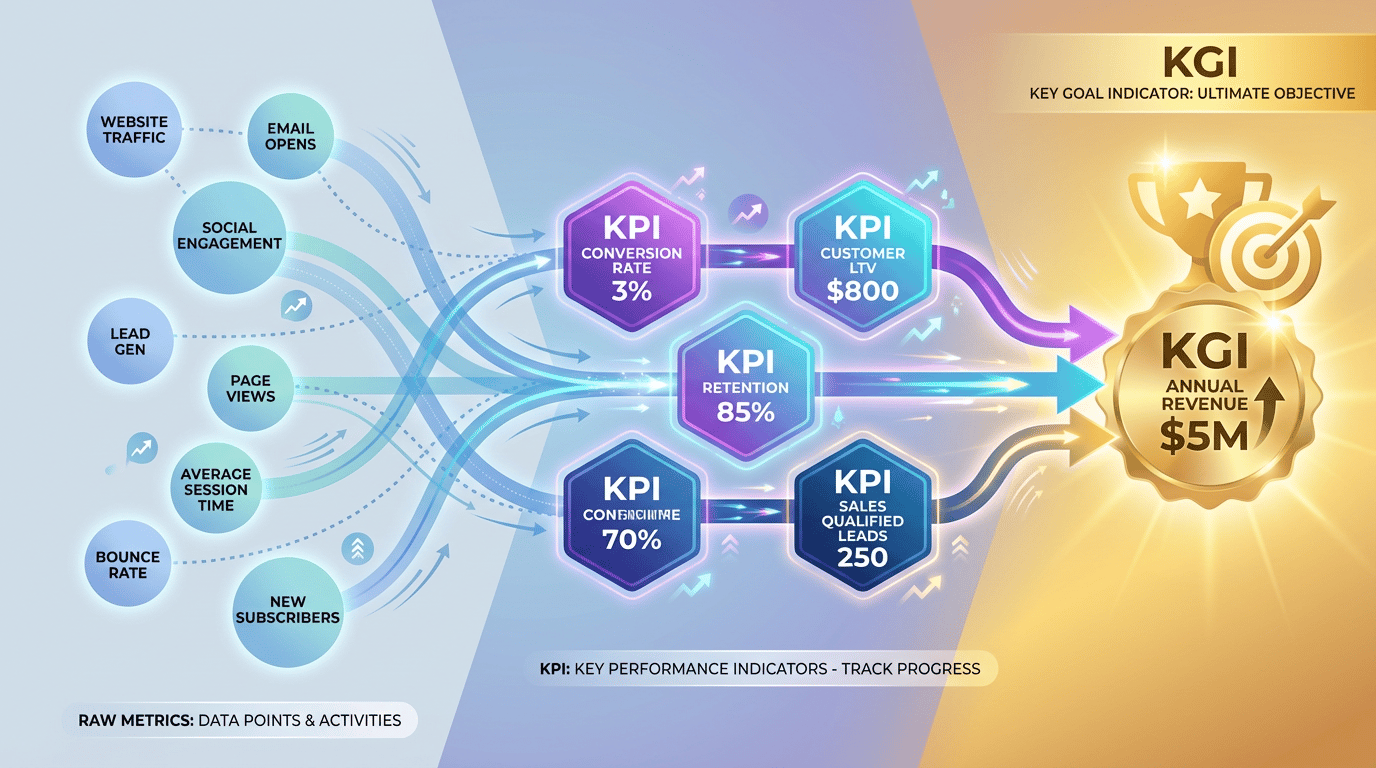
KGI stands for Key Goal Indicator: a measure used to assess whether an intended outcome has been achieved. For example, “annual revenue” is the measure, “$12 million” is its target, and “this fiscal year” is the period. Separating these elements makes a goal easier to evaluate.
This guide uses KGI for a measure placed at the final-outcome level of an organization or project. Terminology varies between organizations. A KPI can also measure an outcome; it is not restricted to intermediate activity.
KGI vs KPI: the practical distinction
ISACA uses KGI and KPI terminology in an information-security context. That usage is evidence of the terms, not a universal naming standard for every business. Agree on definitions within your team.
Term | Meaning here | Hypothetical example |
|---|---|---|
KGI | Measure of the intended final outcome | Monthly product revenue |
KPI | Important measure of progress or performance | Sessions, order rate, average order value |
Target | Desired value of a measure | $300,000 monthly revenue |
Actual | Observed value under the agreed definition | Confirmed revenue for that month |
KSF | Hypothesized key success factor | Reduce uncertainty about delivery terms |
KPI.org describes both leading and lagging indicators. Revenue could be a company-level KGI and a department-level KPI. The review frequency or the seniority of its owner does not settle the distinction. See what a KPI measures for the basic concept.
Five decisions to make before setting a target
- Purpose: State the outcome, such as profitable growth or retention.
- Scope: Specify the product, customer group, currency, and dates.
- Definition: Agree on recognition rules, taxes, refunds, exclusions, and data sources.
- Baseline and target: Consider your history, capacity, budget, and plausible improvement.
- Ownership: Assign reporting, decisions, review dates, and approval for revisions.
A satisfaction goal also needs a survey population, question, and scale. Changing these may break comparability. Industry examples can suggest measures, but their numbers are not automatically suitable targets for your business.
A worked monthly revenue example
The following e-commerce business and figures are hypothetical. Use net product revenue excluding sales tax and shipping, with cancellations and returns reflected consistently in both revenue and orders. These are illustrative assumptions, not benchmarks or a currency conversion of another example.
Monthly revenue = sessions × orders per session × average order value.
Measure | Definition | Plan |
|---|---|---|
Sessions | Visits to the store in the month | 125,000 |
Order rate | Included orders divided by included sessions | 3% or 0.03 |
Orders | Orders within the agreed cancellation and return rules | 3,750 |
Average order value | Included revenue divided by included orders | $80 |
Revenue | 125,000 × 0.03 × $80 | $300,000 |
Working backward gives $300,000 ÷ (0.03 × $80) = 125,000 required sessions. At a hypothetical 2.5% order rate, the same order value would require 150,000 sessions. This is a planning scenario, not a prediction: additional traffic could have different purchase intent and order value.
Orders per session differs from the percentage of sessions containing an order when a session can generate multiple orders. People, users, sessions, and pageviews also have different units. Check the official GA4 definitions and align analytics scope with your order system.
Do not multiply this equation by a repeat-purchase rate again. Repeat orders are already included. If separating new and existing customers, use mutually exclusive groups and add their revenue. Any funnel decomposition must preserve the denominator at each step.
120% of last year's revenue means 20% growth
If hypothetical annual revenue rises from $10 million to $12 million, the current-to-prior ratio is 120%. The growth rate is ($12 million − $10 million) ÷ $10 million = 20%. Write “20% year-over-year growth” or “120% of prior-year revenue.” “120% growth” would mean a different increase.
Connect outcomes to decisions
Sales may use bookings, marketing may use qualified leads, and support may use a defined satisfaction measure. Bookings are not necessarily recognized revenue, and lead volume does not establish sales quality. Add safeguards such as gross profit, accepted opportunities, refunds, or churn.
A KSF is a hypothesis about what matters. Clearer delivery terms might help ordering, but a KPI tree does not prove that a particular change causes growth. For implementation, use our KPI design guide and B2B marketing KPI examples.
Review assumptions when definitions, products, capacity, or budgets materially change. Preserve the original target alongside any approved revision and its reason. Weekly progress meetings need not mean outcomes are mature enough for weekly conclusions. To coordinate project KPIs with monthly budgets and actuals, explore Xtrategy's features.