How to Build a Marketing Dashboard | Design Tips for At-a-Glance KPI Monitoring
Shusaku Yosa
"I have GA4 data, but ad and social media numbers are managed separately" or "I spend hours every week creating reports" — for marketing professionals, fragmented data and manual reporting are major pain points.
The solution is a marketing dashboard. By integrating multiple data sources — GA4, advertising, social media, MA tools, and more — into a single view where KPIs can be grasped at a glance, you dramatically improve the speed and accuracy of decision-making. This article provides a practical guide covering everything from dashboard design and construction to ongoing operations.
What Is a Marketing Dashboard?
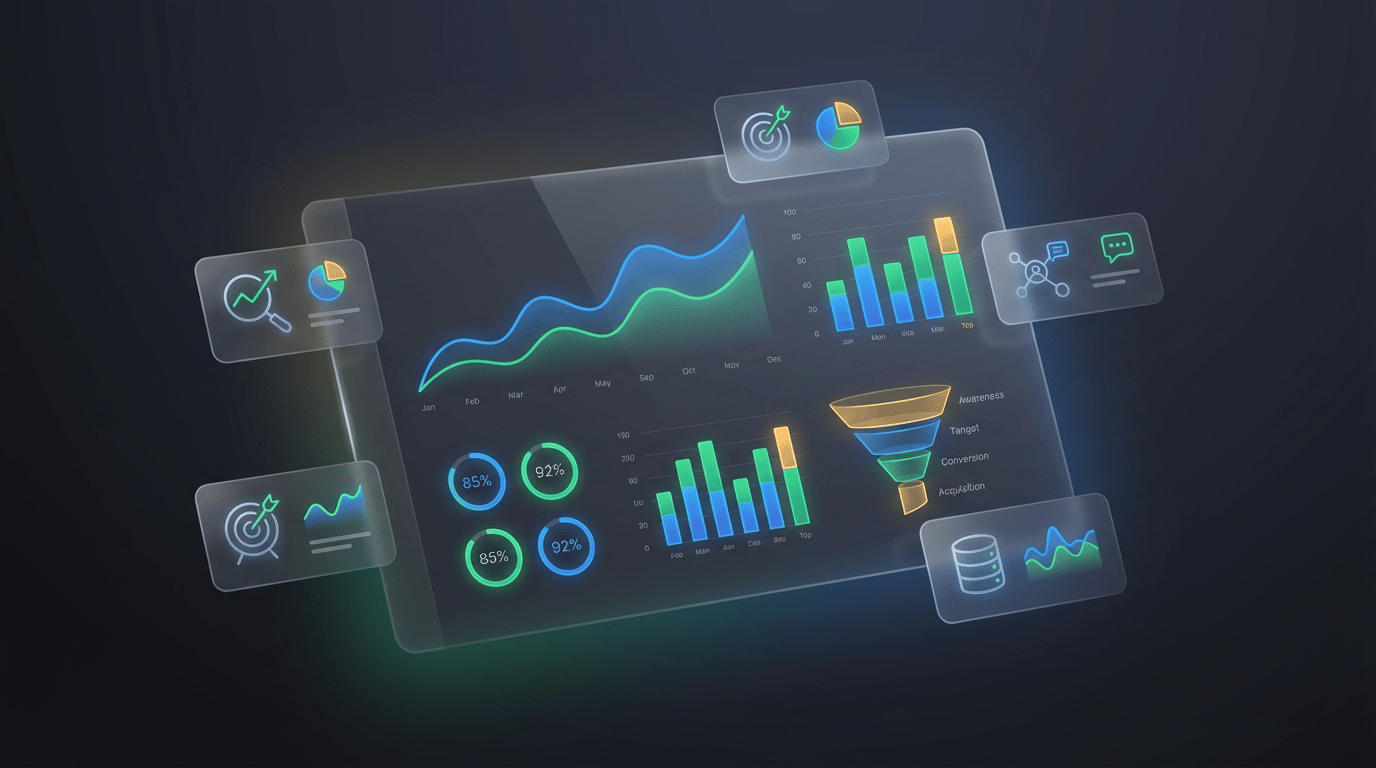
A marketing dashboard is a tool that consolidates data from various marketing activities into a single screen, visualizing KPIs (Key Performance Indicators) in real time. It brings together metrics from Google Analytics, Google Ads, Meta Ads, social media insights, MA tools, and more — data you'd normally have to check by logging into each platform individually — into one unified view.
There are three major benefits of implementing a dashboard. First, it reduces the effort required to check data — no more logging into multiple tools, and report creation time is dramatically shortened. Second, it accelerates decision-making — real-time KPI visibility enables early detection of anomalies and quick course corrections. Third, it creates a common language across teams — when marketing, sales, and leadership all look at the same data, it prevents misalignment and lays the groundwork for constructive discussions.
3 Things to Decide Before Building Your Dashboard
The most common mistake in dashboard building is starting with tool selection. Randomly displaying every available data point only results in a cluttered, unused dashboard. Start by clarifying the following three elements.
1. Define Who Will View It
The granularity of information required varies entirely depending on who views the dashboard. For executives, business impact metrics like revenue contribution and ROI take center stage. For marketing managers, channel-specific CPA (cost per acquisition) and conversion trends are needed. For ad operations specialists, campaign-level impressions, click-through rates, and CPCs are required. Trying to build a "one-size-fits-all" dashboard leads to a mediocre result — ideally, create separate views for each audience.
2. Narrow Down the KPIs to Track
"Measurable metrics" and "KPIs worth tracking" are not the same thing. While GA4 and social media insights offer a vast array of metrics, displaying them all reduces readability and causes you to miss important signals. The most effective KPI selection method is to reverse-engineer from business goals. For example, if your goal is "100 MQLs (Marketing Qualified Leads) per month," the KPIs that emerge naturally are website traffic volume, conversion rate, and contribution by channel. Best practice is to limit each view to around 5 to 8 KPIs.
3. Inventory Your Data Sources
Once you've determined which KPIs to track, audit where that data lives. Typical data sources for a marketing dashboard include GA4 (website traffic and conversion data), Google Ads and Yahoo! Ads (search and display ad data), Meta Ads (Facebook/Instagram ad data), social media insights (engagement data from X, Instagram, LinkedIn, etc.), MA tools (lead counts, scoring, and email delivery data), and CRM (deal and revenue data). Checking each source's API compatibility and export formats in advance will streamline your tool selection.
3 Approaches to Building a Marketing Dashboard
Dashboard construction methods fall into three main categories depending on your resources and technical capabilities. Understand the characteristics and trade-offs of each to choose the best fit.
Approach 1: Use Looker Studio (formerly Google Data Studio)
Google's free BI tool, Looker Studio, is the top choice for building marketing dashboards. It offers native integration with GA4 and Google Ads, enabling basic dashboard creation within minutes. Community connectors allow you to integrate Meta Ads and social media data as well, and you can freely arrange charts and tables with no-code simplicity.
However, there are some limitations in real-time capability, and display speed may decrease as data volume grows. It's ideal for small-scale validation or when Google-based data sources are your primary focus.
Approach 2: Use BI Tools (Tableau, Power BI, etc.)
Full-featured BI tools like Tableau and Microsoft Power BI offer significantly greater flexibility in data integration, transformation, and visualization. They enable you to blend multiple data sources to create custom metrics and drill down into details for advanced analysis needs.
On the other hand, these tools come with licensing costs and a steeper learning curve. They're best suited for teams with data analysis expertise or those requiring complex cross-channel analysis.
Approach 3: Use Marketing-Specific Dashboard Tools
Tools like Databox, Klipfolio, DashThis, or Japan-based NeX-Ray specialize in marketing data integration. These platforms come with pre-built connectors for major marketing tools like GA4, ad platforms, and social media, allowing you to import data with just a few connector settings — drastically reducing setup time.
Many also include marketing-optimized templates and automatic KPI calculation features, making it possible to build high-quality dashboards quickly without specialized BI skills. While there are subscription costs, the total efficiency often makes them worthwhile when factoring in the people-hours saved on construction and operations.
Design Principles for At-a-Glance KPI Dashboards
A dashboard's value is determined more by design than by tool selection. Following these design principles will help you create dashboards that are both easy to read and continuously used.
Organize Information Along the Funnel Structure
The most effective layout for a marketing dashboard follows the funnel structure. Place "Awareness" KPIs (impressions, reach, sessions) at the top, "Consideration" KPIs (engagement rate, resource downloads, webinar registrations) in the middle, and "Acquisition" KPIs (leads, MQLs, opportunities) at the bottom. This layout makes it visually clear where bottlenecks exist in the marketing funnel and highlights exactly what needs improvement.
Combine Scorecards with Trend Charts
An effective way to display each KPI is by pairing scorecards (current value and goal attainment rate) with trend charts (time-series progression). Scorecards give you an instant snapshot of "where things stand now," while trend charts show "how things are trending" — providing both perspectives simultaneously greatly enhances the dashboard's practical utility. Adding color coding (green, yellow, red) for progress against targets makes problem areas visible at a glance.
Include a Channel Comparison View
Since marketing initiatives span multiple channels — SEO, advertising, social media, email — a channel-by-channel performance comparison view is essential. Displaying traffic, conversions, and CPA side by side for each channel makes it easy to make decisions about budget reallocation and where to focus efforts. Visualizing each channel's share using bar charts or pie charts is also an effective approach.
Build in Period Comparisons and Anomaly Alerts
You can only judge whether numbers are "good" or "bad" with a comparison point. Always build period-over-period comparisons (week-over-week, month-over-month, year-over-year) into your dashboard. For example, knowing that sessions are 10,000 means nothing without knowing whether that's +20% or -30% versus last month. Additionally, setting up automatic anomaly alerts when KPIs exceed certain thresholds enables early problem detection and rapid response.
Data Source Integration Methods
How to integrate each data source is a technically important consideration when building a marketing dashboard. Here we explain the connection methods for each major data source.
Integrating GA4 Data
GA4 offers native integration with nearly all BI and dashboard tools. In Looker Studio, you simply select the GA4 connector and specify your property to instantly import data. Setting up BigQuery Export also enables you to freely process and aggregate raw data using SQL. Key GA4 metrics for your dashboard include sessions, users, engagement rate, conversions, and traffic breakdown by channel.
Integrating Ad Data
While Google Ads integrates directly with Looker Studio, cross-platform comparison of Meta Ads, Yahoo! Ads, and other ad platforms typically requires aggregating data through tools like Funnel.io or Supermetrics into spreadsheets or BigQuery. Marketing-specific dashboard tools often come with pre-built connectors for each ad platform, requiring only authentication setup. Key ad metrics to track include impressions, clicks, CTR, CPC, conversions, CPA, and ROAS.
Integrating Social Media Data
Social media data integration can be somewhat complex since each platform has different API specifications and constraints. For Looker Studio, you can use community connectors or output data to spreadsheets via API and then connect. If you're already using social media management tools like Buffer or Hootsuite, leveraging their reporting features is also efficient. Useful social media dashboard metrics include follower growth trends, per-post engagement rates, reach, link clicks, and cross-platform performance comparisons.
Integrating MA & CRM Data
For B2B marketing, integrating data from MA tools (HubSpot, Marketo, SATORI, etc.) and CRM (Salesforce, etc.) into your dashboard enables you to visualize the "ultimate outcome" of marketing activities, beyond just website and ad metrics. Adding metrics such as lead volume trends, MQL-to-SQL conversion rates, pipeline value, and win rates makes it possible to see at a glance how marketing investment is contributing to business results. HubSpot and Salesforce have built-in dashboard features, so a phased approach of first leveraging their native reporting and then integrating with external BI tools as needed is recommended.
5 Tips for Getting Results from Dashboard Operations
A dashboard isn't "build it and forget it" — its value grows through ongoing operations. Here are five key points to keep in mind after construction.
First, incorporate the dashboard into weekly check-in meetings. If there's no habit of looking at the dashboard, it won't get used. Create a routine of screen-sharing the dashboard during weekly meetings to review KPI progress, and a culture of data-driven decision-making will take root.
Second, review KPIs every quarter. As business phases evolve and marketing strategies shift, the KPIs worth tracking will change too. Conduct quarterly reviews to remove outdated metrics and add new ones.
Third, always ask "So what?" to drive action. Simply staring at dashboard numbers won't produce results. Continuously asking "what action should we take based on this change?" is critical. Adding the ability to record action memos directly on the dashboard helps clearly link data to initiatives.
Fourth, maintain data freshness. A dashboard that stops updating quickly loses trust and falls out of use. Ensure automatic refresh settings are properly configured and regularly check for errors caused by data source specification changes.
Fifth, expand incrementally. You don't need to aim for perfection from the start. Begin with basic GA4 and ad metrics, then gradually add social media and MA data as you operate — this phased approach is ultimately the most successful path.
Conclusion: The Dashboard as Your Marketing Decision-Making Foundation
A marketing dashboard is not merely a report automation tool. By integrating scattered data and creating an environment where KPIs can be grasped at a glance, it functions as the "decision-making foundation" for your marketing activities.
To summarize the construction steps: first, clarify your audience and purpose, then narrow down KPIs by reverse-engineering from business goals. Next, inventory your data sources and select the construction method that fits your organization (Looker Studio, BI tools, or specialized tools). In your design, incorporate funnel-structured layouts, scorecard-plus-trend-chart combinations, channel comparisons, and period-over-period comparisons as foundational elements.
Most importantly, don't aim for perfection — start small and keep improving through operations. Begin with GA4 and your primary ad data, and establish the habit of data-driven decision-making within your team.