What Is a Marketing Funnel? Design Methods and the Right Tactics & Tools for Each Stage
Shusaku Yosa
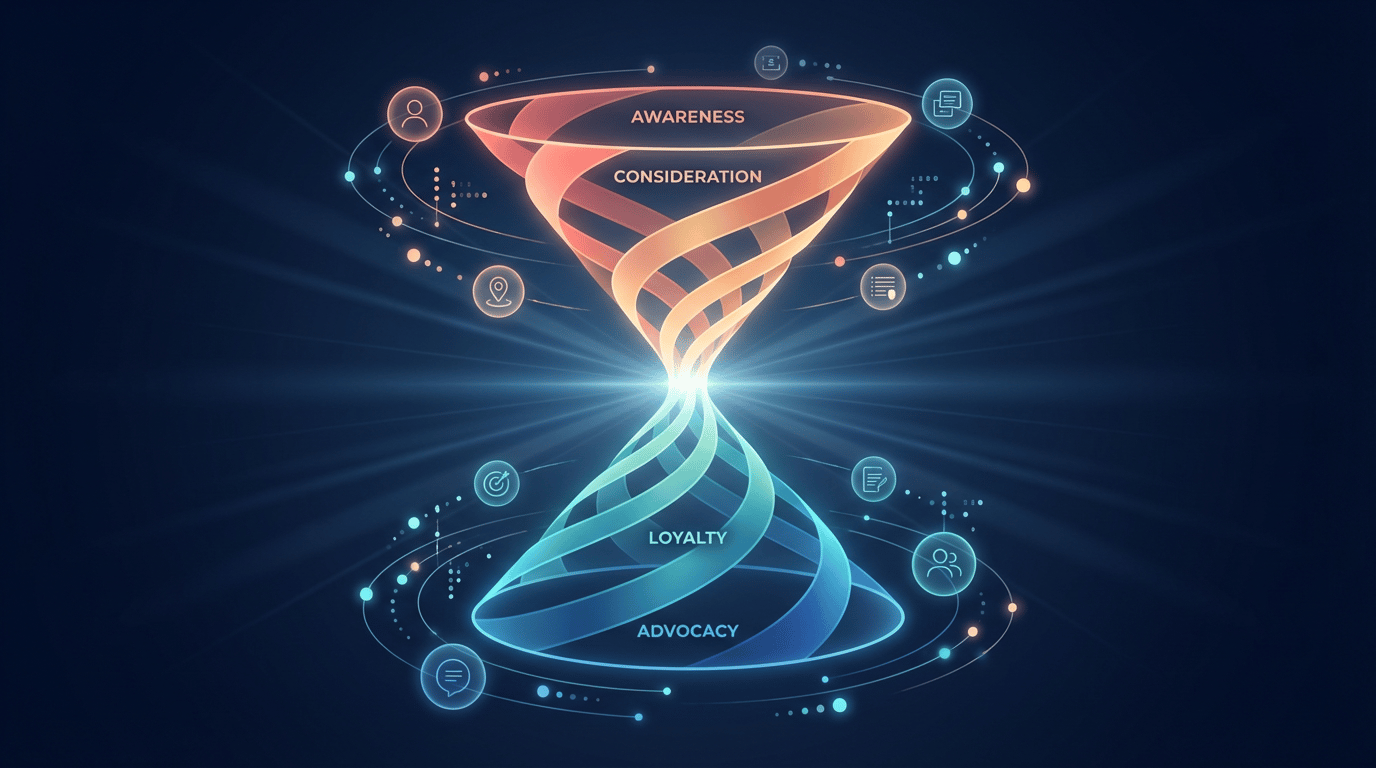
"We're running campaigns but not seeing results." "We can't tell where customers are dropping off." — The foundational framework for solving these challenges is the marketing funnel.
A marketing funnel is a framework that visualizes the process prospects go through — from becoming aware of a product or service, developing interest, comparing options, and ultimately making a purchase. The narrowing shape at each stage resembles a funnel, hence the name.
This article comprehensively covers marketing funnel fundamentals, the three main types, recommended tactics and tools for each stage, a step-by-step design process, and practical application points for both B2B and B2C.
What Is a Marketing Funnel? Core Concepts and History
A marketing funnel is an inverted triangle representing the customer's journey from awareness to purchase. At the top, a large pool of potential customers exists, but numbers decrease at each successive stage. This "narrowing" shape resembles a funnel, giving the framework its name.
Its origins date back to the 1920s. American business writer Samuel Roland Hall proposed the AIDMA model — Attention → Interest → Desire → Memory → Action — which evolved into today's marketing funnel.
The funnel's greatest advantage is making customer drop-off points visible. By identifying bottlenecks and concentrating resources there, you can efficiently improve overall marketing performance. It also provides a shared language across marketing, sales, and customer success teams, enabling organizational alignment toward common goals.
Three Types of Marketing Funnels
There are three major types of marketing funnels. Understand each and choose the right combination for your business.
Purchase Funnel
The purchase funnel is the most fundamental marketing funnel based on the AIDMA model. It consists of four stages: Awareness → Interest → Consideration → Purchase. By visualizing prospect volumes at each phase, you identify bottlenecks. For example, if awareness numbers are strong but the interest conversion rate is low, your interest-building tactics need improvement. This is the most versatile funnel applicable to any business focused on new customer acquisition.
Influence Funnel
The influence funnel focuses on post-purchase customer behavior. It follows the path: Continued Use → Loyalty → Word-of-Mouth → Advocacy/Referral — represented as a triangle expanding upward (opposite to the purchase funnel). This model emphasizes the power of existing customers bringing in new prospects. It's increasingly important in today's landscape where social media and UGC heavily influence purchasing decisions. Particularly effective for e-commerce and subscription businesses where retention directly drives revenue.
Double Funnel
The double funnel combines the purchase funnel and influence funnel into an hourglass shape. It connects the awareness-to-purchase journey with the post-purchase retention, advocacy, and referral process. This enables end-to-end design from new acquisition through customer loyalty to word-of-mouth-driven new leads — making it ideal for companies focused on maximizing LTV.
Differences from Customer Journey and Flywheel Models
While the marketing funnel organizes the purchase process from the company's perspective, the customer journey visualizes the decision-making flow from the customer's perspective. Customer journeys map psychological patterns as customers move between touchpoints like social media and review sites, capturing emotional and awareness shifts. Use customer journeys for specific tactic planning and funnels for big-picture analysis — combining both is most effective.
The flywheel model, unlike the one-directional funnel, maintains customer relationships beyond purchase to accelerate business growth momentum. The cycle of Attract → Engage → Delight creates a virtuous loop where satisfied customers become advocates who attract new customers. Modern marketing requires combining funnel thinking with the flywheel's cyclical perspective.
Tactics and Tools for Each Funnel Stage
Each funnel stage involves different customer states and needs. Let's organize the appropriate tactics and tools for each.
TOFU (Top of Funnel): Awareness Stage
The awareness stage targets potential customers who don't yet know your product. Key tactics include SEO and content marketing for organic traffic, social and display ads for awareness, PR and press releases for media exposure, influencer/creator marketing, and offline channels like OOH and TV advertising.
The critical principle here is providing valuable information addressing your target's pain points — not pushing products. Key KPIs: impressions, reach, CPM, site visits. Effective tools: Google Ads, Meta Ads, X Ads, TikTok Ads, CMS platforms, and creative tools like Canva and Figma.
MOFU (Middle of Funnel): Interest & Consideration Stage
At this stage, prospects who are aware of you are seeking deeper information and beginning comparison. Key tactics: lead magnets (white papers, eBooks), webinars, case studies, email nurturing (drip and segmented campaigns), retargeting ads, and free trials/demos.
The goal is deepening confidence that your solution solves their problem. Key KPIs: leads generated, CPA, CVR, engagement rate. Effective tools: MA platforms (HubSpot, Marketo, SATORI), CRMs (Salesforce, kintone), webinar tools (Zoom Webinars, EventHub).
BOFU (Bottom of Funnel): Purchase & Decision Stage
At the bottom, prospects are actively considering a specific purchase or contract. Key tactics: consultations and sales meetings, proposals and quotes, limited-time offers, purchase UX optimization, and customer testimonials/reviews.
The focus is resolving final objections and providing the closing nudge. Key KPIs: meeting-to-deal rate, close rate, deal size, ROAS. Effective tools: SFA, inside sales tools, chatbots, payment systems.
Post-Purchase: Loyalty & Advocacy Stage
When incorporating the double funnel or flywheel, post-purchase tactics are essential. Key tactics: robust onboarding, loyalty programs, regular NPS surveys, referral program design, UGC campaigns, and customer success strengthening.
Key KPIs: LTV, repeat rate, churn rate, NPS, referral count. Effective tools: customer success platforms (Zendesk, Intercom), NPS tools, loyalty program infrastructure.
5 Steps to Design Your Marketing Funnel
Step 1: Define Personas and Customer Journey
Start by clarifying your target customer persona — demographics, role, industry, challenges, and information-gathering habits. Then map their behavior from awareness to purchase as a customer journey. Combining the funnel with a customer journey enables both big-picture understanding and specific tactic planning.
Step 2: Define Stages and Transition Criteria
Define specific funnel stages for your business. For B2B: Awareness → Lead → MQL → SQL → Opportunity → Closed-Won. Clearly establish what qualifies a prospect to advance to the next stage. Without this clarity, marketing-sales alignment breaks down.
Step 3: Set KPIs for Each Stage
Set KPIs by working backward from your KGI. If your KGI is monthly closed deals, decompose into required opportunities, required MQLs, required leads, and required site visits. Setting stage-to-stage conversion rates helps identify where improvements deliver the greatest impact.
Step 4: Select and Execute Tactics and Tools
Choose specific tactics and tools to achieve each stage's KPIs. Use the TOFU/MOFU/BOFU recommendations as reference, and prioritize execution based on your resources and budget. The key is concentrating on bottleneck stages rather than launching everything simultaneously.
Step 5: Measure, Analyze, and Iterate
Funnels aren't set-and-forget. Regularly measure volumes and conversion rates at each stage, monitoring bottleneck shifts. Consolidate data from GA4, ad measurement tools, and MA platforms into dashboards for weekly and monthly reviews. Continuously asking "Which conversion rate dropped?", "What caused it?", and "What do we fix next?" drives sustained funnel performance improvement.
B2B vs B2C Funnel Application
In B2B, purchase cycles are longer with multiple stakeholders involved. Each stage requires more thorough information: white papers and industry reports at awareness, case studies and product demos at consideration, ROI simulations and custom proposals at decision. The MQL-to-SQL nurturing process is critical, requiring tight MA-SFA integration.
In B2C, purchase cycles are shorter with emotion and impulse playing larger roles. Funnel design emphasizing rapid conversion from social awareness to purchase is key. Influencer marketing, UGC, and live commerce — tactics that blend entertainment with shopping — are gaining traction. The influence funnel (post-purchase word-of-mouth) directly impacts revenue, making it a distinctive B2C focus area.
Is the Marketing Funnel Outdated? Its Relevance Today
Recently, some argue that "the marketing funnel is dead" or "outdated." It's true that with the explosion of social media and online channels, customer purchase journeys no longer follow a neat linear path. Customers move between social platforms, review sites, search engines, and video sites, with funnel stages often occurring out of order.
However, the funnel hasn't become completely obsolete. For B2B's long consideration cycles and B2C's rapid-purchase categories, the funnel's value as a big-picture framework remains strong. The key is using funnels not as perfect purchase process reproductions, but as flexible thinking tools for discovering and resolving bottlenecks.
Today's best practice combines the funnel's linear model with the flywheel's cyclical perspective and the customer journey's customer-centric view. Using all three frameworks together enables cohesive marketing design from new acquisition through LTV maximization.
Common Funnel Mistakes and How to Fix Them
First, vague stage definitions. When marketing and sales don't share clear definitions of "lead" vs "MQL," low-quality leads get passed to sales, tanking conversion rates. Fix: explicitly document transition criteria and get cross-functional agreement.
Second, TOFU over-investment. Over-concentrating budget on awareness generates lead volume that doesn't convert to pipeline or revenue. Fix: set KPIs backward from KGI and maintain balanced investment across the entire funnel.
Third, no post-purchase funnel design. Focusing exclusively on acquisition misses repeat revenue and referral-driven growth. Fix: design with the double funnel in mind, always maintaining an LTV maximization perspective.
Conclusion
The marketing funnel is a century-old framework that remains a powerful thinking tool today. By visualizing the flow from Awareness → Interest → Purchase → Loyalty, identifying stage-by-stage bottlenecks, and taking targeted improvement actions, you can move beyond scattered tactics to results-driven optimization.
Three design essentials: First, define your unique funnel based on personas and customer journeys. Second, set KPIs backward from KGI and focus investment on bottlenecks. Third, design beyond the purchase funnel to include the influence funnel in a double-funnel view.
The funnel isn't a "perfect reproduction of the purchase process" — it's a "map for finding what to improve." Combined with customer journeys and the flywheel model, and continuously evolved, it becomes the foundation for sustained business growth.