What Is Persona Marketing? Design Steps, Templates, and Success Patterns
Shusaku Yosa
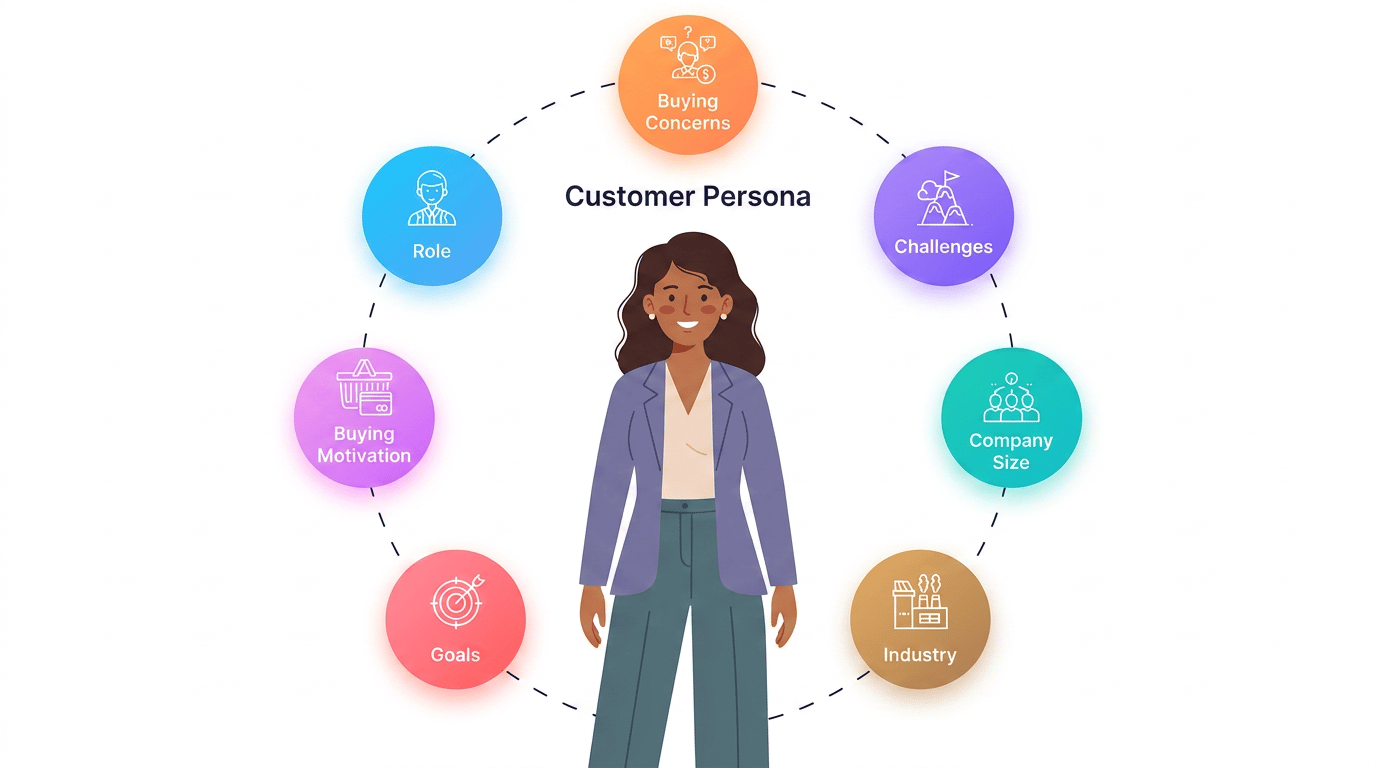
"Every time we build a marketing strategy, the target definition becomes something coarse like 'women in their 20s through 40s,' and we can't pin down whose message we're crafting." "We built a persona, but it's never referenced in subsequent tactical design—we made it and forgot it." "Different departments imagine different customers, so there's no consistency across content, advertising, and sales pitches."—For marketing managers and business leaders, persona marketing is a foundational method for aligning the strategic starting point of "who, what, and how to deliver," yet it's also an area where flawed design and activation easily produce "documents that get created and shelved." This article systematically covers, at a level of granularity you can actually operate in the field, what persona marketing is by basic definition, how it differs from related concepts like target and customer journey, the five steps of design, a template of items you can use immediately, BtoC and BtoB success patterns, and common pitfalls.
What Is Persona Marketing?
Persona marketing refers to the method of portraying your company's ideal customer not just through demographic attributes like age, gender, and occupation, but as "one specific person" including their values, behavior patterns, challenges, information-gathering habits, and purchase decision factors—and then designing product development, content, advertising, and sales activities aimed at that person. While trying to craft "messaging that resonates with everyone" ends up producing bland appeals that resonate with no one, by drilling down into "messaging that resonates most with this one person," you end up producing initiatives that strongly resonate with the broader cluster of customers sharing similar orientations. This is the core philosophy of persona marketing.
The word "persona" originally comes from Latin, meaning "mask" or "role," and traces back to a concept used by psychologist Carl Jung. The persona in marketing is not an actual individual but a fictional human portrait designed as a "condensation of characteristics" extracted from multiple customer datasets, interviews, and behavioral logs. Even though it's fictional, the fact that it's built on real customer data clearly distinguishes it from "mere fantasy"—it functions as a practical reference point for setting the direction of tactics.
Behind the emphasis on persona marketing across BtoC and BtoB industries lies the diversification of customer needs and the fragmentation of information channels. The era when mass advertising of a uniform message to all consumers drove sales has ended. With customers reachable through varied touchpoints—SNS, search, word of mouth, recommenders—reaching them now requires value propositions designed for each customer context. As a means of building shared organizational understanding of "what kind of customer we're facing" and generating consistency across all customer touchpoints from product development through aftersales support, the strategic value of personas is rising.
How Persona Marketing Differs from Related Concepts
Persona marketing is often confused with adjacent concepts such as "target," "segmentation," "customer journey," and "ICP (Ideal Customer Profile)." Understanding these distinctions clearly makes it easier to position personas within your own marketing design.
Persona vs. Target
Target refers to the "segment" of customers you aim to reach, bounded by attributes and conditions. For example, definitions like "women living in the greater metropolitan area, ages 30s through 40s, with household income over $50K" describe a group containing multiple people. Personas, on the other hand, concretely portray "a single person" as the most typical and symbolic figure within that target segment. If target is a "plane," the persona is the "point" at the center of that plane. The standard practice is to use a two-layer design: capture market size and reach with the target, and ensure specificity and consistency of tactics with the persona.
Persona vs. Segmentation
Segmentation is the work of dividing the overall market into meaningful customer groups along various axes such as age, gender, region, behavior, and psychographics. Understanding personas as the process of fleshing out the contents of each segment carved out by segmentation into "a concrete human portrait" makes the relationship easy to organize. Segmentation corresponds to the map-making of "where to aim," while personas describe "what kind of person lives in that place." The two aren't opposing methods. The standard progression is to use them sequentially: segmentation → targeting → persona design.
Persona vs. Customer Journey
Customer journey visualizes the sequence of processes from when a customer becomes aware of a product or service through purchase, usage, and advocacy. Whereas the persona is a static human portrait defining "who," the customer journey is positioned as a dynamic design diagram drawn on a time axis depicting "by what path this person makes decisions." An excellent customer journey is always drawn starting from a specific persona, realistically tracing that person's emotions, thoughts, and behavioral transitions. Personas and journeys are two sides of the same coin. A design that creates only a persona without drawing a journey, or that builds an imagined journey without a defined customer figure, fails to function end-to-end.
Persona vs. ICP (Ideal Customer Profile)
ICP is a concept primarily used in BtoB marketing, defining the outline of your ideal "corporate customer" by industry, company size, revenue, organizational structure, challenges, and similar factors. The persona is positioned as portraying "individuals involved in decision-making or use within the companies defined by ICP," so ICP and persona form a hierarchical relationship. In BtoB, the basic posture is a two-tier design: "which companies to target (ICP) → who within those companies to reach (persona)." Without ICP, drawing only a persona risks investing resources in accounts that resonate but cannot buy—those that won't reach commercialization or won contracts.
Why Persona Marketing Is Gaining Attention and Its Key Benefits
Persona marketing has become a major theme of modern marketing and management because three changes are advancing simultaneously: the fragmentation of customer touchpoints, the increasing complexity of purchasing behavior, and the increasing specialization of organizations. The need to align shared understanding across the organization of "to whom we're directing what" is rising. The larger the marketing investment, the more the persona design quality becomes a management issue determining the precision of tactics and the consistency of the organization.
The first benefit is that the precision and consistency of tactics structurally improve. Clearly defining a persona settles the axis of judgment for every decision: content theme selection, word choice in titles, tone of ad creative, sales talk angles, and more. Judgments of "is this expression right or wrong for this person" can be made on a shared standard rather than gut feel, reducing per-tactic variance and improving brand experience consistency. It becomes the foundation that supports evolution from an organization where tactical quality depends on individual experience and intuition to one that can produce repeatable output grounded in design.
The second benefit is aligning recognition across departments and strengthening cross-functional collaboration. In organizations where marketing, sales, customer success, product development, and customer support each work with different mental images of the customer, tactical direction fragments by department and customer experience develops disconnects. By designing a shared persona and having all departments share that human portrait, the entire organization can image the "experience this customer goes through" at the same resolution, and collaboration across departmental walls begins to function. For executives and business leaders, personas serve the role of "shared language" for permeating strategy throughout the organization.
The third benefit is improvement in the speed and quality of decision-making. When a new tactical idea comes up, you can quickly judge it by asking "will this resonate with the persona?" and "does it align with this person's behavioral context?"—discussion no longer ends in abstraction. Conversely, in organizations without a persona, "who decides" and "on what perspective to evaluate" become vague each time, falling into the inefficiency of re-debating the premises of decision-making for every tactic. Personas are also a practical mechanism for embedding the evaluation axis of tactical decisions into the organization, raising both the speed and reproducibility of decision-making.
Five Steps for Persona Design
Persona marketing doesn't produce results from "a project lead just filling out an attribute table from imagination." It only delivers its true value once you've put in place the complete flow: data collection, hypothesis construction, validation, documentation, and organizational rollout. Use the following five steps to design personas and translate them into tactics.
Step 1: Objective Setting and Scope Clarification
The first thing to do is clearly determine "for what purpose and within what scope" you're building the persona. Even for the same product, the granularity and depth of items to design vary significantly depending on whether the persona is for new product development, content marketing design, ad creative production, or BtoB sales targeting. For example, for a content-marketing persona, the resolution of information-gathering behavior and search keywords is decisively important; for a product-development persona, the deep-dive into usage scenes and inconvenience points takes priority. Beginning design with the use case left ambiguous produces a "persona useful to no one"—comprehensive in items filled but useless in practice.
Regarding scope, when your business has multiple services or customer segments, the recommended approach is to first narrow down to "the single most important segment" and produce one or two personas. Trying to build multiple segments × multiple personas from the start increases design workload and operational burden, causing the practice to atrophy. Personas that function in practice typically start from the segment with the largest revenue contribution or growth opportunity, and only after operations stabilize is the scope expanded.
Step 2: Data Collection | Combining Quantitative and Qualitative Data
Next, collect the data that forms the foundation for assembling the persona. Data broadly divides into "quantitative data" and "qualitative data," and combining both is the iron rule. Quantitative-only data leads to "we understand the trends but can't draw a human portrait," while qualitative-only data results in "vivid but lacking representativeness." Either alone leads to misjudgment.
For quantitative data, leverage customer attribute data and purchase history from CRM, site analytics (GA4), behavioral logs from MA tools, survey results, SNS analytics, and market research reports. From these, grasp the macro trends of "customers with what attributes are exhibiting what behaviors." For qualitative data, leverage 1-on-1 interviews with existing customers and prospects (typically 5–10 people), customer support inquiry logs, sales meeting notes, reviews, word-of-mouth, and comments on SNS, and competitor product review sites. From here, surface the micro-level reality of "in what words the customer actually expresses their concerns and through what thought process they make decisions."
1-on-1 interviews in particular are a decisively important process for drawing out the "raw words," "unexpected motivations," and "hidden dissatisfactions" that desk-bound hypotheses can never deliver. Even with just five interviews, if three or four people share common statements or behavior patterns, that constitutes a strong signal. Questions shouldn't focus on attributes but on story-style prompts like "What triggered you to do X recently?" "What alternatives did you compare at the time?" and "What was the deciding factor?"—the trick is to capture the continuity of behavior and emotion.
Step 3: Hypothesis Construction | Drawing in Three Layers of Attributes, Behavior, and Psychology
Build the persona's human portrait based on the data collected. A good persona is drawn in three layers: "attribute layer," "behavior layer," and "psychology layer." A persona with only the attribute layer carries information no richer than "basically a woman in her 30s" and is barely useful for tactical design. Only by stepping into behavior and psychology does it become a "usable persona" that can produce tactical ideas.
The attribute layer includes the persona's name (fictional), age, gender, residence, occupation, role, income, family composition, and education. These are the foundational information that sketches the outline of the figure, helping you imagine the persona as a single person. The behavior layer includes typical weekday and weekend patterns, information-gathering methods (media usually consumed / SNS / search behavior), purchase behavior (where, how compared, with whose advice purchased), currently used related services, and use of free time. The psychology layer includes values, things treasured, challenges and concerns currently faced, future goals, judgment criteria for purchase decisions, and risks to avoid.
Among the three layers, what most affects tactical design is the "behavior layer" and the "psychology layer." For example, knowing the behavior of "watches X (formerly Twitter) for 15 minutes on the commute every morning" enables the tactical decision to place ads there. Knowing the psychology of "wants to try anything that saves time, but doesn't want to make investments she can't explain to her family" sets the direction for how the product is shown and how pricing is positioned. Building the skeleton of the human portrait through attributes and fleshing in the "context of judgment and motivation" through behavior and psychology—only then does the persona function as the starting point of tactical design.
Step 4: Documentation and Sharing
Once the persona is designed, document it in a form usable across the organization. Ideally, organize it as a "persona sheet" that lets you see the whole picture on a single A4 sheet or one slide. Too much information and no one will read it; too little and it's unusable as material for tactical design. The standard format visually organizes: name (fictional), photo (image), attribute data, typical day, challenges and goals, purchase decision factors, frequently used media and search keywords, and a list of things to avoid.
After documentation, always conduct sharing sessions and discussions across all relevant departments. Even if only marketing grasps the persona, if sales, development, CS, and support operate on different customer images, organizational coordination won't function. In sharing sessions, concretely discuss "what would change if we reviewed current tactics through this persona" and "how each department can use this persona." The decisively important process is permeating the persona as "the axis of operational judgment" rather than as an abstract document. Establishing operational rules to ask "how does this look to the persona?" at the start of sales meetings and product development meetings dramatically accelerates adoption.
Step 5: Validation and Continuous Updates
The persona isn't "build once and done"—update it continuously as the market, customers, and your business phase change. When the product expands to new customer segments, when industry trends or consumer behavior shift, and when your business strategy pivots, always check whether the persona's premises have diverged from reality. The recommended cadence is two-layer operation: a regular review at least once a year, plus ad-hoc reviews whenever major business changes occur.
Persona validation is most effective when conducted by cross-checking against tactical results. Continuously verify through data: "Is the content built for this persona actually reaching the intended segment?" "Are the ad audience and persona aligned?" "How well does the real profile of acquired customers match the persona?" When divergence is large, distinguish whether the persona itself doesn't match reality, or whether tactics fail to reflect the persona, and correct the persona side or the tactics side accordingly. The operational posture of continuously refining the persona within the "feedback loop with reality" elevates both tactical outcomes and organizational learning.
Persona Design Template | Item List You Can Use Immediately
Here's a standard item template useful when designing a persona from scratch. You don't need to fill in every item—select based on your use case while at minimum choosing an item set that lets you draw the three layers of "attributes, behavior, and psychology."
Basic Attributes (Profile)
Name (fictional—always assign a name to add specificity), age, gender, residence (state/province and city level), occupation/industry/role, scale of employer, income, family composition (presence of spouse and children, with ages), highest education, hobbies and interests. For BtoB personas, also include the affiliated company's industry, size, department, scope of duties, and presence of budget authority. These are foundational information that sketches the outline of the figure. Adding a photo image or a one-line catchphrase makes the persona easier to remember within the team.
Behavioral Data (Daily Patterns and Purchase Behavior)
Typical weekday timeline (wake → commute → work → return home → bedtime), weekend patterns, information-gathering methods (media usually consumed, SNS, YouTube, news apps, search engines), frequently searched keywords and topics of interest, purchase behavior characteristics (compares thoroughly / decides quickly, brick-and-mortar / EC, word-of-mouth-focused / price-focused / brand-focused), currently used related services and competitor products, SNS usage (per-platform usage patterns and typical time slots). These become practical decision materials for determining the destination, timing, and format of tactics.
Psychological Data (Values, Concerns, Decision-Making)
Cherished values, lifestyle preferences, concerns and challenges currently faced (specifically enumerated as a "struggle list"), goals to achieve and ideal state, priority ordering of judgment criteria in purchase decisions, risks and anxieties to avoid, and past purchase failures. The purpose of psychological data is to portray at high resolution "what this person delights in, what they find stressful, and what they seek, from waking up to falling asleep." Personas thin in this layer become "unused personas."
Relationship with Your Product
Current awareness of your product or service (don't know at all / heard of but never used / under consideration / currently using), expected purchase barriers (price, features, trust, persuading those around them, switching costs from existing services, etc.), experiences and outcomes expected after purchase, elements likely to be the deciding factor pushing them to purchase, and conditions for recommending after use. In BtoB, also organize the role division between decision-makers, end users, and purchasing personnel, and the focus axis of each.
A One-Line Catchphrase
Finally, it's recommended to add a "catchphrase" that expresses the persona in one line. For example: "A dual-income working mother in her 30s struggling to balance time efficiency with time with family," or "The information systems director at a mid-sized manufacturer, tasked with DX promotion but struggling with internal consensus-building." Expressing the essence of the figure in a single line helps shared understanding take root within the organization. Rather than long documents, this single line is what gets repeatedly cited at the tactical front line—a characteristic shared by organizations that successfully operationalize personas.
Success Patterns in Persona Marketing
Specific cases from real companies tend to be confidential and difficult to generalize, so this article introduces three "structural patterns of success cases" widely observed in industry. Use the pattern closest to your business model as a reference for assembling the direction of design and operations.
BtoC | Improving Ad Efficiency with Life-Stage-Based Personas
A frequently observed BtoC success pattern is the method of designing personas around "life stage," which directly drives purchase decisions. In industries where changes in age and family composition strongly regulate purchase motivation—such as cosmetics, food, housing, education, and finance—personas are designed at the life-stage level: "A dual-income couple expecting a child," "A mother whose child is entering elementary school," "A working woman in her 50s who has begun caring for an aging parent." By creating ad creative, LP messaging, and content tone for each persona, fit with the target segment rises, leading to improvement in efficiency metrics such as CPA and CVR. The key is not to bracket by age alone, but to portray the figure through the life-event context of "what they're thinking and seeking at this particular time."
BtoB | Role-Based Personas to Strengthen Sales-Marketing Coordination
A representative BtoB success pattern is designing personas for each of the multiple roles involved in purchase decision-making (decision-maker, project sponsor, end user, procurement) and designing the content and sales approach for each persona. For example, with SaaS products, separate content is prepared for CFOs and CEOs covering "investment ROI and company-wide impact" and for line managers covering "how daily work changes," and ABM (Account-Based Marketing) is used to approach multiple personas within the same company in parallel. When the content supplied by marketing and the talk track used by sales on customer visits link up on shared persona understanding, both commercialization rate and win rate improve.
Product Development | Persona-Driven Planning to Accelerate Development Decisions
In the product-development context, a success pattern is embedding the persona as the axis of planning discussions. By instituting the rule of always asking "how does this change function for this persona?" at decision points—adding new features, modifying existing features, changing the UI—the speed and consistency of development decisions improve. When internal stakeholders argue from personal preferences and ideas, consensus-building takes time. By using a shared persona as the standard, the discussion shifts from "whose opinion is correct" to the objective question of "what's correct for the persona." It functions as a powerful organizational mechanism supporting designs in which the product's core value doesn't drift from customer context.
Common Failures and Pitfalls in Persona Marketing
Persona marketing is a powerful method, but mistakes in design or operation invite failures such as "satisfaction with just having built it," "becoming a fictional ideal disconnected from reality," or "becoming a dormant document never referenced in tactics." Recognize the representative pitfalls and consciously avoid them in design and operation.
The first is building a persona based only on a project lead's imagination, without grounding in data. Filling out an attribute table only on the hypothesis of "our customers are probably like this" without referring to interviews or customer data produces a "customer figure that the office wants to see"—different from actual customers—and pushes tactics in the wrong direction. The crucial discipline is to always build on a foundation of at least five interviews with existing customers or prospects, quantitative data from CRM and GA4, and qualitative data from SNS and review sites, assembling a "human portrait backed by data."
The second is creating a "thin persona" composed only of attribute data. A persona that just fills in attribute items like age, gender, occupation, and income offers no material for tactical decisions. The resolution of behavior and psychology—"What does this person think, where do they look, what concerns them, what delights them, from when they wake up to when they fall asleep?"—determines the persona's practical utility. Adhering to a three-layer design that draws the outline through attributes and fleshes out context through behavior and psychology is the greatest dividing line between usable and unusable personas.
The third is creating too many personas, leaving every one at half-resolution. Businesses with multiple segments are tempted to comprehensively make "one persona per segment," but trying to design 5–10 personas from the start burdens operations and causes the practice to atrophy. The established practice for maximizing results within limited resources is the sequence of "narrow down → drill deep → expand": deeply design the most important one or two personas, use them across the organization, and only then add the next persona.
The fourth is the designed persona not being shared and activated across the organization, ending up asleep in the back of a document folder. Even when the marketing department builds the persona alone, if sales, development, and CS don't know about it, organizational coordination doesn't emerge. By holding sharing sessions with all departments after design, concretely discussing how each department uses it in operations, and embedding operational rules to ask "how does this look to the persona?" at the start of regular meetings, the persona transforms from a "document" to "the axis of operational judgment."
The fifth is creating the persona once and never updating it, widening the gap with reality. Because markets, customers, and your strategy constantly change, operating on outdated persona premises mass-produces tactics disconnected from actual customers. Embedding a regular review at least once a year and ad-hoc reviews whenever major business changes occur into operational rules, and continuously updating based on feedback from tactical results and the real customer profile, is the prerequisite for keeping the persona alive.
The sixth is treating the persona as absolute, then missing market-wide movements and unexpected needs. The persona is meant to indicate "the typical central figure," not an exclusionary restriction of "we only deal with this person." While using the persona as a baseline, maintaining the multi-lens perspective of continuously observing data, voices from the field, and market trends—so as not to overlook signals such as unexpected positive reception from outside segments or the emergence of new needs—supports both long-term business expansion and the development of new segments.
Summary
Persona marketing is the set of methods through which companies portray their ideal customer as a single specific person in three layers of attributes, behavior, and psychology, and then design product development, content, advertising, and sales activities aimed at that person. Distinguishing its role from adjacent concepts—target, segmentation, customer journey, and ICP—and designing at a granularity that matches your business phase and use case are the prerequisites for raising tactical precision and organizational consistency.
The true value of persona marketing lies in three dimensions: improvement in tactical precision and consistency, strengthening of organizational coordination through unified inter-department recognition, and improvement in the speed and quality of decision-making. By steadily running the five steps—objective setting and scope clarification, data collection combining quantitative and qualitative sources, hypothesis construction in three layers of attributes, behavior, and psychology, documentation and sharing across all departments, validation and continuous updates—and leveraging template items such as attribute profile, behavioral data, psychological data, relationship with your product, and a one-line catchphrase, persona marketing functions as the strategic starting point of the modern marketing department. By avoiding the six pitfalls—imagination not grounded in data, thin design with only attributes, too many personas, lack of organizational activation, insufficient updates, and excessive absolutism—and by continuously refining personas within the "feedback loop with reality," persona marketing continues to function over the long term as a central management activity of modern marketing that generates both tactical precision and organizational consistency.