What Is Program Management? How to Bundle Multiple Projects and Maximize Outcomes
Shusaku Yosa
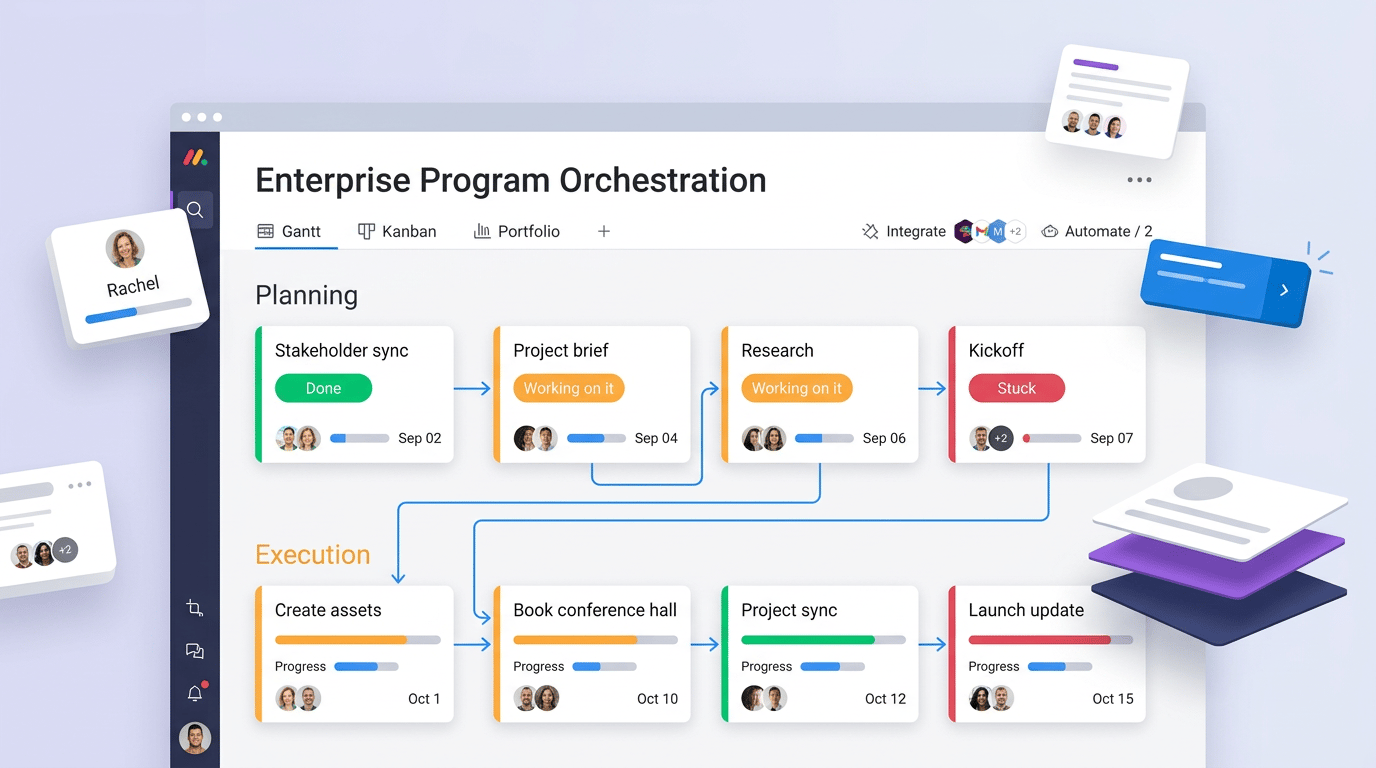
"Ten projects tied to a new product launch are running in parallel, but no one can tell whether they are heading toward the goal as a whole." "Every individual project is on schedule, yet the combined business outcome is not landing." For business leaders, PMOs, and corporate planning staff who run many projects, the need to operate "the outcome as a whole" in an integrated way—something that individual project management alone cannot capture—has been rising every year. The operating discipline of bundling multiple independent projects, such as marketing campaign portfolios, new-business launches, DX initiatives, and post-merger integration (PMI), and steering them toward a single strategic outcome is called program management. This article systematically covers what program management is, how it differs from project management, portfolio management, and PMO, three benefits (ensuring strategy alignment, optimizing resource allocation, and maximizing benefits), the 5 steps from program-charter drafting through governance design, component planning, benefits realization management, and transition/closure, the main use cases in marketing/DX/new business/PMI, and common pitfalls such as disconnect from strategy, project bolt-on, undefined benefits, hollow governance, and dumping responsibility on the PMO.
What Is Program Management?
Program management is a management approach that systematically bundles related projects, subprograms, and program activities (collectively called "components") aimed at realizing a strategic objective, and operates them to obtain integrated benefits that individual management could not. The Project Management Institute (PMI) defines a "program" as "a group of related projects, subprograms, and program activities that are managed in a coordinated manner to obtain benefits not available from managing them individually," with an independent body of knowledge (The Standard for Program Management) maintained separately from the project management body.
The essence of program management is not "making each individual project succeed" but "maximizing strategic benefits by operating a portfolio of projects in an integrated way." For example, the multiple projects tied to a new product launch—marketing campaigns, sales-organization changes, customer-success setup, brand refresh, sales-data foundation—may each succeed on their own, yet often fail to add up to the final benefit of "establishing the new product in the market and growing revenue." Program management fills the gap between local optimum and global optimum, sitting as an important management layer between strategy and on-the-ground projects.
The reason program management is treated as important across BtoB SaaS, consulting, manufacturing, finance, and the public sector is the rise in business complexity and the explosion in project counts. With themes such as digitalization, globalization, regulatory response, ESG/sustainability, and M&A running in parallel, it is not unusual for a single organization to have over 100 projects in flight at any given time. Simply raising the success rate of individual projects is no longer enough to achieve strategic targets. Program management has become an essential skill set of modern management, alongside the maturation of PMO functions and the spread of product-management culture, as an organizational response to this complexity.
How Program Management Differs from Related Concepts
Program management is often confused with adjacent terms like project management, portfolio management, PMO, and product management. Drawing the distinctions clearly makes it easier to position program management correctly in your own organizational design.
Program Management vs. Project Management
Project management is the discipline of completing an individual project under defined scope, schedule, and budget to produce a unique deliverable (product, service, or result). Program management is the higher-order discipline of bundling multiple projects to obtain "integrated benefits that individual management cannot produce," with scope, time horizon, and outcome metrics one level up from project management. While a project ends with "delivery of the artifact," a program ends with "realization of strategic benefits," and explicitly covers the operating phase after project delivery. In practice, the standard structure is one program manager overseeing multiple project managers, bundling their projects toward the strategic objective.
Program Management vs. Portfolio Management
Portfolio management is the management-layer practice of strategically selecting, prioritizing, and allocating resources across multiple programs, projects, and related work. While program management bundles related projects to achieve a specific strategic objective, portfolio management evaluates every program and project the organization holds against strategic alignment and optimizes the investment mix. The hierarchy is "Portfolio ⊃ Program ⊃ Project": portfolios decide "what to do," programs "bundle related efforts and execute them," and projects "deliver individual artifacts." Typically the CIO or CSO (Chief Strategy Officer) owns portfolio management, business leaders and program managers own program management, and PMs own project management—a pattern that maps cleanly to the organizational hierarchy.
Program Management vs. PMO
A PMO (Project Management Office) is an organizational function or department that standardizes, supports, and governs project management; it builds methodologies and templates and supports projects across the organization horizontally. While program management is "a temporary endeavor that executes related projects toward a specific strategic objective," a PMO is "a standing function that continuously raises project-management capability across the organization." It is increasingly common to place a Program Management Office (same acronym, different context) inside the PMO to support specific programs, but they are best understood as different things. The complementary relationship is that program managers execute programs using templates and governance established by the PMO.
Program Management vs. Product Management
Product management is the continuous management of a specific product or service across its entire lifecycle (concept, development, launch, growth, improvement, retirement), and it has been established as a specialized role mainly in the SaaS industry in recent years. While program management is "a temporary endeavor with a start and an end aimed at achieving a strategic objective," product management is "an ongoing activity that continues as long as the product exists"—a difference in time horizon. At the same time, the launch phase of a new product often requires program-management techniques (integrated operation of multiple projects), which are then handed off to product management—so there is continuity between the two. They are not opposites; they are used differently depending on organizational phase and target.
Why Program Management Is Getting Attention—and Its Benefits
Program management is being reappraised in modern management, PMOs, and corporate planning because themes such as digital transformation, globalization, regulatory response, and M&A run in parallel, and stacking up individual project management is no longer enough to achieve strategic targets. Large enterprises that run dozens to hundreds of projects annually are the obvious case, but even fast-growing startups quickly fall into "individual successes but no business outcome" without integrated operation of related projects. Program management has become an important topic alongside PMO sophistication and the strengthening of corporate planning functions as the operating discipline that resolves this structural challenge.
The first benefit is the structural assurance of alignment between strategy and on-the-ground projects. Targets set in corporate or business strategy are hard to decompose into individual projects as-is, and on the ground people often just "do the tasks they are told to do" without the strategic intent ever coming through. Program management captures strategic intent in documents such as the Program Charter, the Benefits Realization Plan, and the Program Roadmap, putting every component project in motion toward the same north star. The result is an organization that detects misalignment between strategy and execution early and corrects course.
The second benefit is global optimization of resource allocation—people, budget, and time. Under individual project management alone, each PM fights for the best people and the largest budget to make their own project succeed, and the resulting "scramble for resources" tends to drop overall organizational productivity. In program management, the program manager has the authority and accountability to govern resource allocation across components, concentrate people and budget on the highest-priority projects, and resolve bottlenecks. The result is the ability to extract the maximum strategic outcome from limited organizational resources.
The third benefit is the ability to chase benefits realization all the way through. Projects are too often treated as "complete" at the moment of artifact delivery, but real value emerges during the operating phase that follows. For example, a new CRM rollout project is not complete the moment the system goes live—it generates outcomes only when the sales organization actually uses it and win rates climb. Program management uses Benefits Realization Management to keep tracking benefits measurement, adoption support, and continuous improvement after project completion, structurally preventing "build it and forget it." This is a strength of program management that individual project management does not have.
Main Use Cases for Program Management
Program management is widely applied in situations that demand "integrated operation of multiple projects along a strategic theme." Knowing the four typical use cases makes it easier to identify where to apply program management in your own organization.
Launching New Products and Services
The most typical use is operating new product and service launches. Getting a new product to market means 10 to 20 projects running in parallel: product development, brand design, marketing campaigns, sales enablement, customer-support setup, distribution partner development, PR/communications, data foundations. Managing these individually leads to handoff failures such as "the product shipped but sales still can't sell it" or "ads launched but the landing page is not ready." When a program manager builds the schedule backward from launch day and manages the dependencies and critical path across components, the impact of market entry is maximized.
DX (Digital Transformation) Initiatives
DX initiatives are, by their nature, themes where program management is indispensable. They are large-scale efforts where wide-ranging projects—core systems renewal, data-foundation construction, business-process redesign, organizational change, talent development, governance setup—run in parallel over 3 to 5 years, with the CDO (Chief Digital Officer) or DX office typically acting as the program manager. The decisive factor in DX success is benefits realization management that goes beyond individual technology rollouts to include on-the-ground adoption, ROI realization, and changes in organizational culture.
Post-Merger Integration (PMI)
The post-merger integration process that follows an M&A close (PMI: Post-Merger Integration) is a textbook application area for program management. Multiple projects of very different natures—financial integration, HR integration, IT integration, brand integration, organizational restructuring, site consolidation, supplier unification—run in parallel over 2 to 3 years to deliver synergy realization as the strategic benefit. The royal road is to assign a dedicated PMI program manager (the integration lead) who, from Day 1 (closing day), develops a 100-day plan, a 1-year plan, and a 3-year plan, and oversees component execution and synergy realization.
Marketing Campaign Programs
In marketing too, program management that bundles multiple campaigns and initiatives is spreading. An annual marketing plan is a collection of independent efforts—new-product launch campaigns, year-end sales, seasonal campaigns, brand refresh, content-marketing acceleration, MA-operations maturity—and optimizing each in isolation creates conflicts in budget allocation, headcount allocation, and message consistency. When a marketing program manager (or a program manager reporting to the CMO) operates the campaign portfolio in an integrated way, aligned with brand strategy and revenue targets, the ROI of marketing investment as a whole rises.
5 Steps to Operate Program Management
Program management does not work as a stapled-together pile of projects. The full impact emerges only when the steps from program-charter drafting through governance design, component planning, benefits realization management, and transition/closure are connected into a single flow. Use the following 5 steps.
Step 1: Program Charter and Benefits Definition
The first decision is "why this program exists" and "what benefit it ultimately delivers." A Program Charter is a 1–2 page document that captures the program's purpose, strategy alignment, expected benefits, key stakeholders, success metrics, and major constraints, and it is finalized with sign-off from the executive sponsor and major department heads. Benefits are defined in measurable terms (KPIs) such as "revenue +X billion," "lead generation +X%," "X hours of operational time saved," with qualitative goals noted alongside. If the charter and benefit definitions are vague when execution starts, components drift into local optimization, and at the end of the program no strategic outcome can be shown—the worst-case pattern.
Step 2: Governance Design and Steering Committee Setup
Next, design the governance structure that governs the program. Define clearly the roles and authority of the program sponsor (the executive decision-maker), the steering committee (the department-head-level decision body), the program manager (the execution lead), the project managers (component leads), and the support functions (PMO, finance, legal, IT). Document the decision flow, escalation paths, and review cadence (monthly/biweekly/weekly). Run the steering committee roughly monthly, reviewing program-wide progress, risks, budget, and benefits realization, and treat it as the venue for major decisions such as adding, shrinking, or stopping components. Weak governance means inter-project conflicts drag on, and program-wide decisions slow down fatally.
Step 3: Component Planning and Roadmap
Once governance is set, enumerate the components (projects, subprograms, related work) that make up the program and build a unified roadmap that integrates their dependencies, priorities, and schedules. Because each component has its own project plan, the program manager focuses on interface management: "which component must finish when," and "how does a delay in one ripple to the others." Identifying the critical path (the bottleneck path that determines the overall schedule) and visualizing dependency points where risk is most likely to surface structurally reduces overall delay risk. Share the roadmap with stakeholders in multiple representations: Gantt, kanban, and dependency matrix.
Step 4: Benefits Realization Management and Progress Tracking
During execution, in addition to component-level progress tracking, run continuous tracking of benefits realization. The Benefits Realization Plan maps over time "which benefit is realized by the completion of which component, when, and to what extent," and compares actuals to plan on a monthly or quarterly basis. For example, against a benefit target of "10% improvement in sales productivity 3 months after CRM rollout completion," monitor whether the actual productivity metric is climbing as planned; if not, fire additional adoption support, training, or process changes. Even if every component finishes on plan, if benefits do not materialize, the program has failed. Chasing this all the way through is the core of program management.
Step 5: Transition and Program Closure
Once benefits realization comes into view, plan the transition from the program into steady-state operations. Because a program is "a temporary endeavor with a start and an end," it does not continue forever; you hand off the artifacts produced, the operating know-how, and the accountability for continued benefits realization to the business owner, the product owner, and the operations team, and then close the program. At closure, produce a program-wide outcome report, lessons learned, an open-issues list, and a handover plan for continued benefits measurement, and end the program formally with steering-committee approval. Accumulating lessons learned in the organizational knowledge base raises the success probability of the next program over time, starting a cycle of organizational learning.
Common Pitfalls and Cautions in Program Management
Program management is a powerful management practice, but design and operational missteps can invite failure modes such as "it becomes a pile of projects and no benefit is delivered," "only governance meetings increase and the field gets exhausted," and "it gets dumped on the PMO and accountability becomes unclear." Recognize the typical pitfalls and steer around them deliberately.
The first is disconnect from strategy. The most typical failure pattern is when the Program Charter is drafted in isolation from corporate or business strategy, and the component projects cannot answer "why does this program need to exist." When drafting the charter, make explicit which elements of corporate strategy the program commits to, which other programs it interlocks with, and which financial indicators (revenue, profit, market share) it ultimately contributes to—and maintain the discipline of confirming strategic alignment in every quarterly review.
The second is project bolt-on. A "program" that merely staples together pre-existing projects after the fact, without designing inter-component coherence, priority, or benefits linkage, is a program management nameplate with no substance. To make something a program, the role each component plays must be explicit in the Benefits Realization Plan, and there must be controls that prevent each PM from independently moving the schedule. To prevent bolt-on, keep asking "could the benefit still be realized without this component?"
The third is undefined or unmeasured benefits. A program that puts up the banner of "DX initiative" or "new product launch program" without quantifying what success means cannot articulate outcomes at the end and leaves the impression in the organization that "program management is a ritual." Always define benefits as measurable KPIs, decide the owner of measurement, the timing, and the data source as a set, and write them into the Benefits Realization Plan before execution begins.
The fourth is hollow governance. A steering committee that meets monthly but where participants see the materials for the first time on the day, the discussion gets lost in operational minutiae, and important decisions are deferred, is not functioning as governance. Drive the basics—distribute materials in advance (at least 3 business days), share minutes within 48 hours, make decisions explicit, track open items—and establish the discipline that the steering committee is a venue for strategic decision-making.
The fifth is dumping the program on the PMO and leaving accountability ambiguous. Positioning program management as "the PMO's job" while business leaders and sponsors fail to act as accountable owners is a high-probability path to program failure. The PMO is a process-and-governance support function; ultimate accountability for strategic decisions, resource allocation, and benefits realization sits with the program sponsor (the executive) and the program manager (the business leader). Use a RACI chart (responsibility matrix) to make "who is accountable for what" explicit, and structurally prevent over-reliance on the PMO.
Summary
Program management is a management approach that systematically bundles related projects, subprograms, and related work toward a strategic objective and operates them to obtain integrated benefits that individual management could not. Distinguishing it clearly from project management, portfolio management, PMO, and product management, and designing it to fit your strategic theme, organizational scale, and complexity, is the prerequisite for realizing strategy and building organizational capability.
The real value of program management lies in three dimensions: structurally ensuring alignment between strategy and on-the-ground projects, allocating resources at the global optimum, and chasing benefits realization all the way through—supporting diverse strategic scenarios from new product launches and DX initiatives to post-merger integration and marketing campaign programs. By steadily turning the 5 steps—program charter and benefits definition, governance design and steering committee setup, component planning and roadmap, benefits realization management and progress tracking, transition and program closure—and avoiding the pitfalls of disconnect from strategy, project bolt-on, undefined benefits, hollow governance, and dumping the work on the PMO, program management keeps functioning over the long term as a core management foundation that generates strategic execution power and organizational learning across modern management, PMOs, and corporate planning.