What Is a CMS? How It Works, Top Tools Compared, and How to Choose
Shusaku Yosa
"I want to revamp our website, but I don't know which CMS to choose." "What can a CMS actually do?" These are common questions among marketing and web professionals. In this article, we provide a comprehensive overview of CMS fundamentals, compare major tools, and explain how to select the right CMS for your organization.
What Is a CMS?
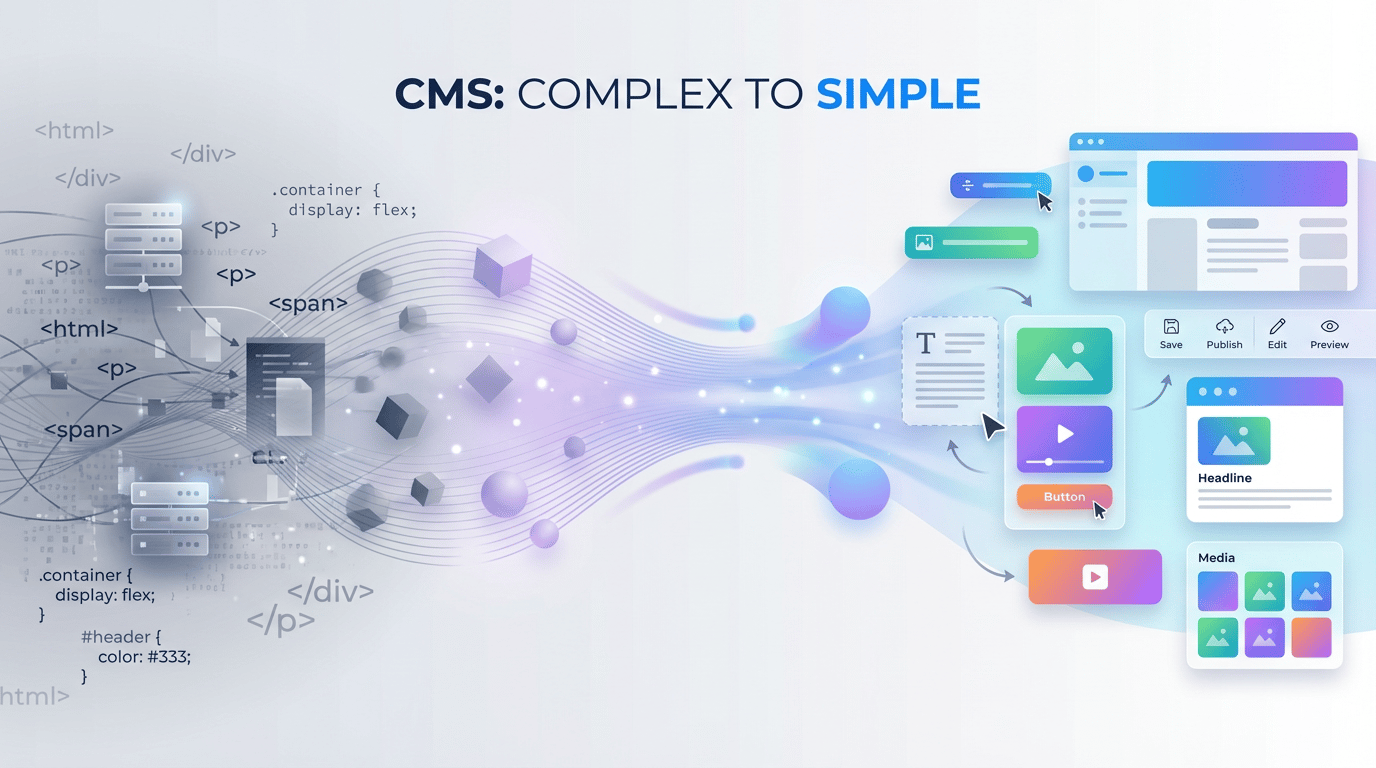
CMS stands for Content Management System — software that lets you create, edit, and manage website content without specialized programming skills. The key advantage is that you can publish pages simply by entering text and images through an admin panel, without writing HTML or CSS directly.
Traditionally, adding or updating web pages required asking a developer for help every time. With a CMS, marketing staff and editors can update content themselves, dramatically speeding up time-to-publish and reducing operational costs.
How a CMS Works
A CMS is broadly composed of two functions: content management and content delivery.
The content management function stores assets such as text, images, and videos in a database and lets you edit and organize them through an admin interface. User permission management and workflows (draft → review → publish) are also part of this layer.
The content delivery function combines stored data with templates to output HTML pages served to visitors' browsers. By switching themes or templates, you can refresh the design without changing any content.
Types of CMS
CMSs generally fall into three categories. Understanding each type makes it easier to find the right tool for your needs.
Open-Source CMS
These are CMSs with publicly available source code that can be used for free. The most prominent example is WordPress, which powers roughly 43% of all websites worldwide. Open-source CMSs offer rich plugin and theme ecosystems with high extensibility, but security patches and server administration are your responsibility.
Cloud-Based CMS (SaaS)
With a SaaS CMS the vendor manages all servers and software; users pay a monthly fee and operate entirely through their browser. Representative examples include Wix, Squarespace, and Shopify (for e-commerce). Setup is fast because no server management is required, but customization flexibility can be limited.
Headless CMS
A headless CMS completely separates content management (back end) from presentation (front end). Content is delivered via APIs, so the same content can be served not only to websites but also to mobile apps, digital signage, and other channels. Leading tools include Contentful, Strapi, microCMS, and Payload CMS. Development freedom is very high, but a separate front end must be built.
Comparing Major CMS Tools
Below is a comparison of representative CMS tools organized by use case.
WordPress
The world's most widely used open-source CMS. It can handle everything from blogs and corporate sites to e-commerce stores. With over 60,000 plugins and 10,000+ themes available, features like SEO optimization and form creation are relatively easy to implement. However, ongoing maintenance for plugin management and security updates is essential.
Shopify
A cloud-based CMS specialized for e-commerce. Product management, payments, inventory, and shipping integrations come built-in. Themes and apps let you extend your store, making it suitable for everything from small individual shops to large-scale D2C brands.
Wix
A cloud-based CMS that lets you build websites with drag-and-drop. It offers a rich selection of design templates and requires no coding to produce visually appealing sites quickly. It is well suited for freelancers, small businesses, and portfolio sites.
Contentful
A leading headless CMS built on an API-first philosophy. It allows flexible content modeling and provides both REST and GraphQL APIs. Contentful is widely adopted by global enterprises and excels at multilingual support and large-scale content delivery.
microCMS
A headless CMS born in Japan, featuring a fully Japanese UI and support. It manages content via APIs and integrates easily with modern front-end frameworks like Next.js and Nuxt.js. Adoption is growing rapidly in Japan, from startups to mid-sized companies.
5 Key Points for Choosing a CMS
There are too many CMSs to compare them all. Prioritize the following five criteria to efficiently narrow down the best fit for your organization.
1. Site Purpose and Scale
If your focus is blogging or owned media, WordPress or a headless CMS is a strong choice. For e-commerce, look at Shopify. For a quick corporate site, Wix or Squarespace may be ideal. The best answer depends on your goals. Also factor in future page counts and traffic growth.
2. In-House Technical Resources
Whether you have developers on staff significantly changes your options. With strong engineering resources, you can leverage the flexibility of headless or open-source CMSs. If non-engineers will run the site, a SaaS CMS is far less burdensome.
3. Cost Structure
Compare total cost of ownership (TCO) — not just the CMS license fee, but also hosting, plugin or app costs, customization development, and the personnel costs of ongoing maintenance. It is not uncommon for a free open-source CMS to end up more expensive than a SaaS solution once operations are included.
4. SEO and Marketing Features
Check whether the CMS provides SEO-critical features such as meta-tag editing, customizable URL structures, structured-data output, and page-speed optimization. Peripheral capabilities like A/B testing, form builders, and analytics integrations are also important evaluation criteria.
5. Security and Extensibility
Because a CMS is an internet-facing system, security is non-negotiable. Evaluate vulnerability response speed, granularity of user-permission controls, SSL support, and WAF integration. Extensibility — the ability to add or change features as your business grows — is equally important from a long-term perspective.
How to Roll Out a CMS
A typical CMS rollout follows these steps. First, clarify your site's purpose and goals (KPIs). Next, list your functional requirements and shortlist three to five candidate CMSs. Then, try each one through free trials or demo environments to evaluate usability and the admin experience. Finally, make your decision based on a holistic assessment of cost, features, and operational burden.
After launch, define operational rules — update frequency, responsible persons, and approval workflows — to get the most out of your CMS.
Conclusion
A CMS is the mechanism for efficiently managing and publishing website content, and it is a critical foundation that shapes the speed and effectiveness of your marketing activities. Open-source, cloud-based, and headless CMSs each have their strengths, so the key to success is prioritizing across five dimensions: purpose, technical resources, cost, SEO requirements, and security. Start by trialing your candidate tools and experiencing how they work firsthand.