How to Build an Advertising Strategy: A Practical Guide to Objective Design, Channel Selection, and Budget Allocation
Shusaku Yosa
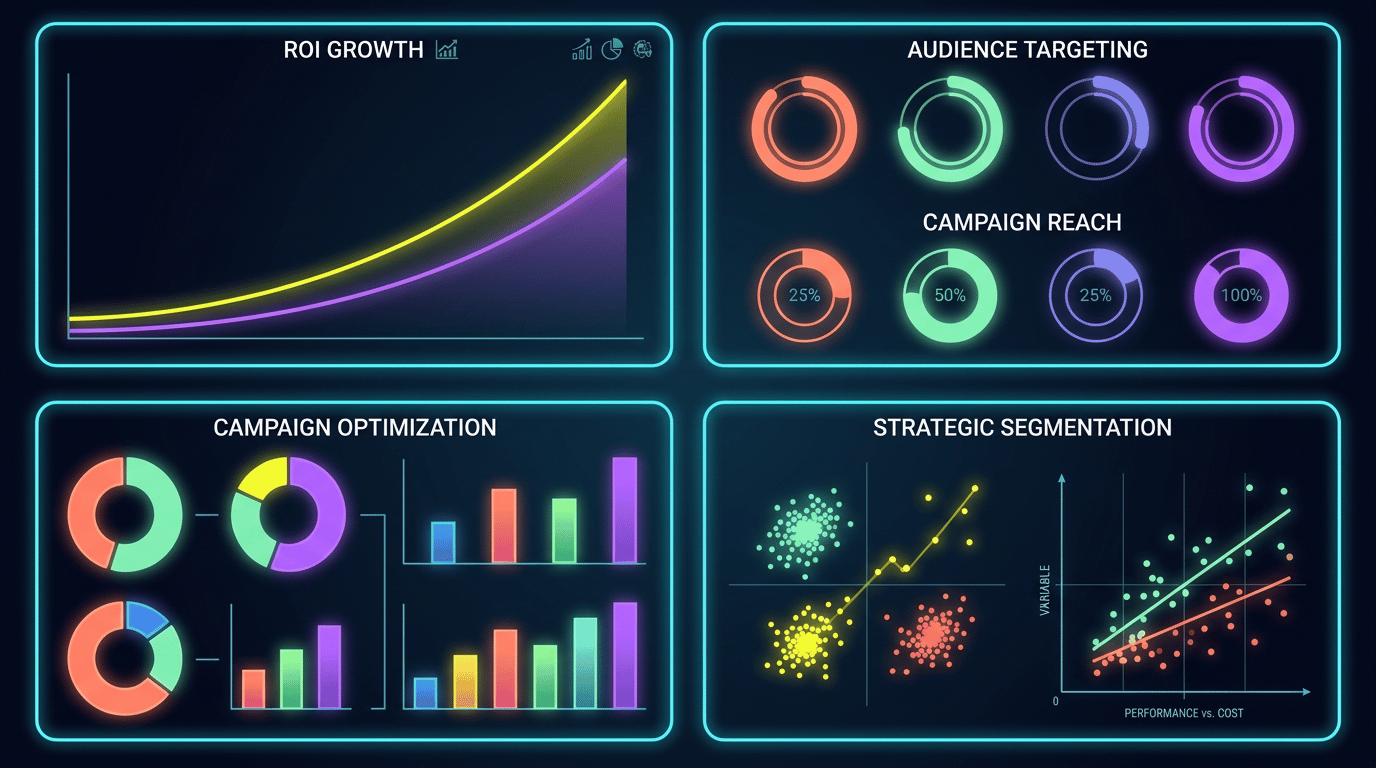
Advertising channels keep proliferating — search, social, display, video, DOOH — and we hear the same complaints again and again: "I don't know where to put the budget," "we run individual channels but I can't tell if they're driving business outcomes." In most cases, the root cause isn't whether one tactic is good or bad. It's that the overall advertising strategy hasn't been designed.
This article walks through the practical steps for building an advertising strategy from the ground up, in order: objective design, target design, message design, channel selection, budget allocation, KPI design, and operations and improvement. Whether you're a business owner ramping up advertising for the first time or a marketer rebuilding an existing program, this framework is meant to be usable starting tomorrow.
What is an advertising strategy?
An advertising strategy is the medium- to long-term blueprint that defines, in service of your business goals: who you target, what you say, which channels you use, how much you spend, and in what sequence you deploy. It sits one level above tactics like channel-specific bidding strategies or creative production — it governs the prioritization and budget-allocation decisions that cut across multiple channels and campaigns.
Strategy vs. planning vs. operations
In practice, "advertising strategy," "advertising plan," and "advertising operations" get used interchangeably, but they operate at different levels of granularity and different time horizons. Strategy is the half-year to one-year layer that defines the business-wide advertising investment policy. Planning is the quarter-to-month layer that decides the specific campaign mix and budget allocation. Operations is the day-to-day to weekly layer that optimizes bids, delivery, and creative. When the strategy layer is missing, even precise planning and operations will produce investments that are off-target relative to business goals.
What happens without an advertising strategy
When channel operations proceed without a strategy, the same problems show up in predictable ways:
Channel owners move in different directions, and messaging and customer experience lose coherence
Budget allocation has no clear rationale, and money keeps flowing to the same channels by inertia
Short-term CPA becomes the only evaluation lens, and brand or upper-funnel investment never gets built
You can see channel-level CPA, but you can't explain the connection to business KGIs (revenue, LTV)
Responses to competitor activity and platform algorithm changes become reactive and ad-hoc
Advertising strategy is also a tool for deciding what NOT to spend on. To maximize results within a finite ad budget, you need an articulated set of decision criteria, shared across the organization.
How to build an advertising strategy: the seven-step overview
An advertising strategy is built in the following seven steps. Each step builds on the outputs of the previous one — skip a step and you'll hit contradictions downstream.
Objective design (work backward from business goals to define advertising's role)
Target design (segmentation and persona definition)
Message design (articulate the core proposition and creative direction)
Channel selection (assemble the media portfolio)
Budget allocation (design allocation across short- and long-term, and across funnel stages)
KPI design (connect channel-level KPIs to business KGIs in a tree)
Operations and improvement (establish the PDCA cycle and decision-making process)
Maintaining a clear set of outputs from each step — objective definition document, persona document, messaging map, media portfolio table, budget allocation table, KPI tree, operations flowchart — lets the whole strategy fit on a single page. That makes internal alignment and ongoing operations far smoother.
Step 1: Design objectives by working backward from business goals
The starting point of any advertising strategy is to clearly define the role advertising should play in service of the business goal. Advertising is not a general-purpose tool — it has distinct strengths across acquiring new awareness, driving purchase consideration, reactivating existing customers, and so on. If you don't decide upfront what you're asking advertising to do, channel selection and KPI design will drift.
Work backward from business goals to advertising goals
Start from the business goal (e.g., "next year's revenue of $15M, 600 new customer accounts, 20% lift in existing-customer LTV") and decompose what advertising should contribute. In B2B, the core metrics tend to be "meeting count" and "MQL/SQL count"; in B2C, they're "site-driven revenue," "new buyers," and "branded search volume." After making the role split between advertising and other functions (sales, CS, SEO, content) explicit, define the mission of the ad budget in concrete numbers.
Define objectives by funnel stage
Advertising objectives differ completely depending on which stage of the purchase funnel you're strengthening. Loading multiple objectives onto a single ad budget blurs both channel selection and creative design.
Awareness: getting your brand name and value proposition in front of people for the first time (branded search volume, brand lift as indicators)
Interest: prompting recall among those with a relevant problem (site visits, content views as indicators)
Consideration: providing decision-making material to prospects comparing alternatives (whitepaper downloads, webinar signups as indicators)
Decision: providing the final nudge for prospects right before conversion (CV count, CPA, ROAS as indicators)
Existing-customer activation: prompting repeat purchase and upsell among existing customers (repeat purchase rate, LTV growth rate as indicators)
The rule of thumb is one primary objective per campaign. When you do load multiple objectives onto one campaign, make the primary and secondary objectives explicit, and split your evaluation KPIs by stage accordingly.
Sharpen targets with the SMART framework
Goal-setting quality is enforced through the SMART framework — Specific, Measurable, Achievable, Relevant, Time-bound. Instead of "increase inquiries through advertising," aim for resolution at the level of "double monthly inquiries from advertising from 80 to 160 by the end of next year's first half." Vague goals make it impossible to judge success after launch, and they make improvement decisions arbitrary.
Step 2: Design targets and bring personas to life
Once objectives are set, the next question is who you're reaching. Running ads with a fuzzy target leads to channel selection, audience setting, and creative all converging on average — which is the textbook recipe for CPA stagnation.
Segmentation and targeting
Split the total market through segmentation, then narrow to the segments you want to serve through targeting. Typical axes in B2B are industry, company size, role, and problem area; in B2C, age, gender, life stage, values, and purchase frequency. The segments you go after change with business stage, so it helps to separate the current core target from the expansion target — this keeps judgment from drifting.
Translate to ad platform audience capabilities
Whether your target design actually works in the field depends on how well you can reproduce defined targets through each platform's audience capabilities. Google Ads custom audiences, Meta's detailed targeting, LinkedIn's job-title/industry targeting — the signals available differ by platform. Translate the persona defined in strategy into a channel-by-channel audience design table; the post-launch operational lift is substantial.
Personas raise the resolution of decision-making
Once you've defined the target segment, develop a representative person as a persona. Go beyond attribute data into problems, information-gathering behavior, decision-making process, media consumption, and pre-purchase anxieties. That psychological resolution is what lets a persona actually serve as a decision criterion for creative and landing pages. Always use customer voice from sales and customer support, and customer interviews from existing customers, as raw material — it's how you keep the persona from becoming an abstract construct.
Step 3: Design messaging and articulate the core proposition
With targets defined, the next step is articulating what to say to them. Ad creative quality is what ultimately drives CPA and CVR, but no matter how much you polish creative, if the underlying proposition is weak, results won't move.
Define the value proposition and benefits
Build the proposition with the customer's outcome (Benefit), not the product's function (Feature), as the subject. Instead of "provides inventory management functionality," say "eliminates lost sales from stock-out and missed reorders." Speaking value in the context of solving the persona's problem produces a coherent end-to-end pitch — from ad creative to landing page to sales deck.
Get the differentiation pitch down to one line
Advertising is a medium that compels decision-making in limited time and limited space. It is essential to sharpen down to a single line: what's different about you, and why should they choose you? Articulate the USP (Unique Selling Proposition) and treat that articulation as the common core message across all channels and all creative. Doing this keeps the proposition from drifting as you run multiple campaigns in parallel.
Use different messages at different funnel stages
Even for the same product, you need different messages: at awareness, "a message that surfaces the problem"; at consideration, "a message that establishes a comparison axis and differentiation"; right before purchase, "a message that removes the final anxiety." Build a messaging matrix on a funnel × persona grid in advance, and downstream creative production scales much more easily.
Step 4: Select channels and build the media portfolio
With objective, target, and message defined, you select the channels to execute. The most common mistake here is to pick channels because they're trendy or because competitors are using them. The rule is to articulate selection criteria and narrow down to channels that align with your strategic priorities.
Major ad channel categories
Ad channels fall broadly into the categories below. Each has different objective strengths, time-to-result, and required budget scale.
Search ads: delivered to users with explicit search intent. Strong at consideration through decision
Display ads: image/banner delivery to a wide range of inventory. Effective for awareness and retargeting
Video ads (YouTube, TikTok, Reels): visual + audio. Strong at awareness expansion and brand penetration
Social ads (Meta, X, LinkedIn, TikTok): high audience precision, broad interest-based reach
Shopping ads (Google Shopping, Amazon Ads): capture users right before purchase, especially in e-commerce
App ads (UAC, ASA): specialized for app install acquisition
DSP and programmatic: audience-based delivery across multiple properties
DOOH, TV, radio: offline media, broad awareness and brand penetration
Five criteria for channel selection
Narrow channel candidates by evaluating each on the five axes below. Building a channel-selection matrix with ratings on each axis is also useful for internal alignment.
Fit with objective: does the channel's strength match the funnel stage you're targeting (awareness vs. capture)?
Target reachability: is there enough volume of your persona on this channel, and can the channel's audience features reproduce your target?
Fit with budget scale: does minimum spend and expected CPM/CPC let you reach meaningful volume within your budget?
Time to result: does the channel's nature match the speed you need (immediate capture vs. medium-term effect)?
Creative production feasibility: can you continuously supply the required formats (vertical video, static, long-form copy)?
Combine channels with portfolio thinking
Rather than concentrating on one channel, the standard pattern is to combine upper-funnel awareness media with lower-funnel capture media. For example: "build upper-funnel awareness on YouTube and Meta, then capture consideration-through-CV with Google search ads." Spell out the role split between channels. From a risk-diversification standpoint, spreading across multiple channels also dampens the impact of algorithm shifts and platform policy changes.
Step 5: Design budget allocation with intentional emphasis
Once the media portfolio is set, decide the budget allocation across channels. The quality of an advertising strategy ultimately shows up in how the budget gets allocated. A budget whose rationale can't be explained is hard to get internal approval for, and post-launch improvement decisions become equally murky.
Allocate budget by funnel stage
The first step in allocation is deciding what percentage of the budget goes to each funnel stage — awareness, interest, consideration, decision, and existing-customer activation. If you want to maximize short-term CV, lean lower-funnel; if you're going after medium-term business growth, lean upper-funnel. Calibrate the balance to your business stage. As a general starting point, lower funnel (capture) 50–70% and upper funnel (awareness, interest) 30–50% — though optimal ratios vary significantly by industry and business stage.
Secure experimentation budget with the 70-20-10 rule
Concentrating the full budget on known winners erodes resilience to channel fatigue and market change. A workable rule of thumb is to allocate 70% to proven primary tactics, 20% to secondary tactics where improvement is in reach, and 10% to new experimental channels or formats. When learnings from the experimentation budget feed into the next cycle's primary tactics, you get continuous strategic evolution.
Set both upper and lower bounds per channel
Set channel budgets from both sides: an upper bound "this is the max we can spend" derived from target CPA, and a lower bound "the minimum spend the channel's machine learning needs to function." Half-measure allocations below the lower bound trip a common trap: the channel's optimization engine can't operate, and CPA worsens. Social and video ads in particular need enough volume for machine learning to stabilize before they can be evaluated at all — always check minimum spend requirements before adding a new channel.
Initial allocation and monthly review cycle
Set initial allocation tentatively, based on past performance, industry benchmarks, and expected ROI. The key is treating the initial allocation as a hypothesis. Design a cycle of monthly performance review and quarterly major reallocation — that keeps the strategy from ossifying and lets it track market changes.
Step 6: Design KPIs that connect to business KGIs
Once budget is allocated, design the system to measure and evaluate each tactic's results. Sloppy KPI design means that after launch you can't agree on what counts as success, and improvement decisions stop working. Advertising in particular tends to be evaluated solely on "channel-level CPA," but that alone can't explain business contribution.
Build a KPI tree from business KGI down
Build the KPI tree with the top-level KGI (revenue, new customer count — whatever the business goal is) at the apex, then decompose down through mid-level KPIs and channel-level KPIs. For a B2B SaaS example: "annual new ARR" at the top, with "meeting count × win rate × average price" in the middle, and below that "ad-driven meeting count," "ad-driven MQL count," and "impressions × CTR × CVR × meeting conversion rate" as channel KPIs. Two things determine the quality of the tree: that the math holds from top to bottom, and that each KPI has a named owner.
Channel-level KPIs in three layers (delivery, efficiency, outcome)
Organizing channel KPIs into three layers makes improvement decisions easier:
Delivery metrics: impressions, reach, frequency, view-through rate (volume and how it's reaching)
Efficiency metrics: CTR, CPC, CVR, CPA (how efficiently delivery converts to results)
Outcome metrics: CV count, revenue, ROAS, meeting count, LTV (contribution to the business)
When you can identify which of the three layers a problem lives in — "delivery is happening but no one clicks (creative problem)," "clicks happen but no CV (LP problem)," "CV happens but revenue doesn't grow (target precision problem)" — improvement priorities sort themselves out.
Use attribution to measure upper-funnel contribution
Last-click-only evaluation systematically underestimates awareness and brand advertising, and the result is a biased program that just keeps pumping more into capture ads. It's worth supplementing with tools like Google Analytics' data-driven attribution or MMM (Marketing Mix Modeling) — anything that can measure the contribution of upper-funnel tactics. Perfect attribution doesn't exist; the realistic approach is to "pick one primary evaluation logic and unify operational decisions around it."
Make day-to-day and monthly operations visible through dashboards
KPIs aren't "set and forget" — they need to be in a form that the operations team uses for daily judgment. Build cross-channel dashboards in tools like Looker Studio, Tableau, or other BI products, and use separate views for daily anomaly detection, weekly progress checks, and monthly retrospective. For leadership, prepare a separate view that shows "contribution to business KGI" rather than channel-level CPA — it makes the case for the ad budget at the cross-organizational level.
Step 7: Build the operations and improvement cycle
Building a strategy is much easier than keeping one running. In this final step, you put organization, operational flow, and improvement cycles in place so the strategy can actually be executed.
Decide the in-house vs. outsourced split
Ad operations spans strategy design, channel operation, creative production, landing page production, measurement, and reporting — few organizations can cover all of that in-house. The realistic approach is to make a split: "strategy and decision-making in-house, channel operations and creative with external partners," and build the internal procurement structure and direction skills to match. Document who approves what, and what gets reported to which meeting body each month — that stabilizes operations.
PDCA cycle across daily, weekly, monthly, and quarterly cadences
Ad operations PDCA is best designed by layer. Daily: anomaly detection and emergency stop decisions. Weekly: bid, budget, and creative fine-tuning. Monthly: channel-level KPI review and mid-scale tactical decisions. Quarterly: media portfolio review and budget reallocation. Separating themes and decision rights by layer keeps discussions focused and makes day-to-day operations easier to run.
Make creative testing a continuous operation
It's not an overstatement to say that ad performance is ultimately decided by the volume and speed of creative testing. How many new creatives you ship per month, how many A/B tests you run, how you propagate winners into the next cycle — turning that creative workflow into a standing operation is the final piece that connects strategy to results. If creative production capacity is tight, generative AI and video template tools are worth considering.
Make learning institutional
The lessons from individual campaigns — what worked, what failed — should not stay in the heads of the people who ran them; they should accumulate as organizational knowledge. Leaving each campaign's brief, results report, and lessons-learned as a three-document set in a common format means strategic continuity survives team transitions and partner changes.
Common failures in advertising strategy
Finally, five common failure patterns in strategy and operations. Keeping them in mind during strategy design substantially reduces downstream rework.
Failure 1: Strategy is built channel-first
When discussion starts from "let's run Meta" or "let's start TikTok," objectives, targets, and KPIs get bolted on after the fact, and strategic coherence collapses. Avoidance: lock down steps 1–3 (objective, target, message) first, then evaluate channels through the step 4 selection criteria and decide adoption.
Failure 2: Channels are evaluated only on short-term CPA
If you allocate budget based purely on channel-level CPA, money concentrates on capture-focused search ads, upper-funnel traffic dries up, and within a few quarters even capture CPA degrades. Avoidance: design an attribution logic in step 6 and include upper-funnel contribution in the evaluation.
Failure 3: Personas aren't translated into channel audiences
Defining personas carefully doesn't help if the design for reproducing them through each channel's audience features is missing — strategy and field operations diverge. Avoidance: at step 2, build a "persona × channel audience setting" matrix and align with channel operators.
Failure 4: Budget allocation has no defensible rationale
"Same allocation as last year," "increased it because sales asked" — budget rationales like these make post-launch review decisions equally unclear. Avoidance: at step 5, explicitly document funnel-based allocation and 70-20-10 experimentation budget, and capture the allocation rationale in a one-pager.
Failure 5: Strategy is set but never enters operations
An impressive strategy document that doesn't get used in monthly meetings or daily decisions effectively doesn't exist. Avoidance: at step 7, design the strategy together with the dashboards, meeting cadence, and report templates that make it operational — and make explicit who references it, when, and where.
Summary: build advertising strategy systematically in seven steps
An advertising strategy is built systematically in seven steps: objective design, target design, message design, channel selection, budget allocation, KPI design, and operations and improvement. What matters is understanding the structural point — each step builds on the previous one, and skipping order guarantees breakdown downstream.
Three things turn strategy into results: first, connecting channel-level CPA to business contribution through a KPI tree derived from business KGIs; second, putting emphasis into budget allocation through funnel-based allocation and 70-20-10 thinking; third, taking strategy all the way through to operational form including dashboards and meeting bodies. With these three in place, advertising strategy stops being a plan document and becomes the mechanism by which the organization continuously compounds results.
Cross-channel budget allocation and measurement, and funnel-level KPI integration, are areas where spreadsheet-based operations tend to break down. Xtrategy is a platform that supports marketing budget allocation and measurement in an integrated way — useful as the operational backbone for advertising strategy.