What Is the Difference Between CAC and CPA? Definition, Calculation, and Usage
Shusaku Yosa
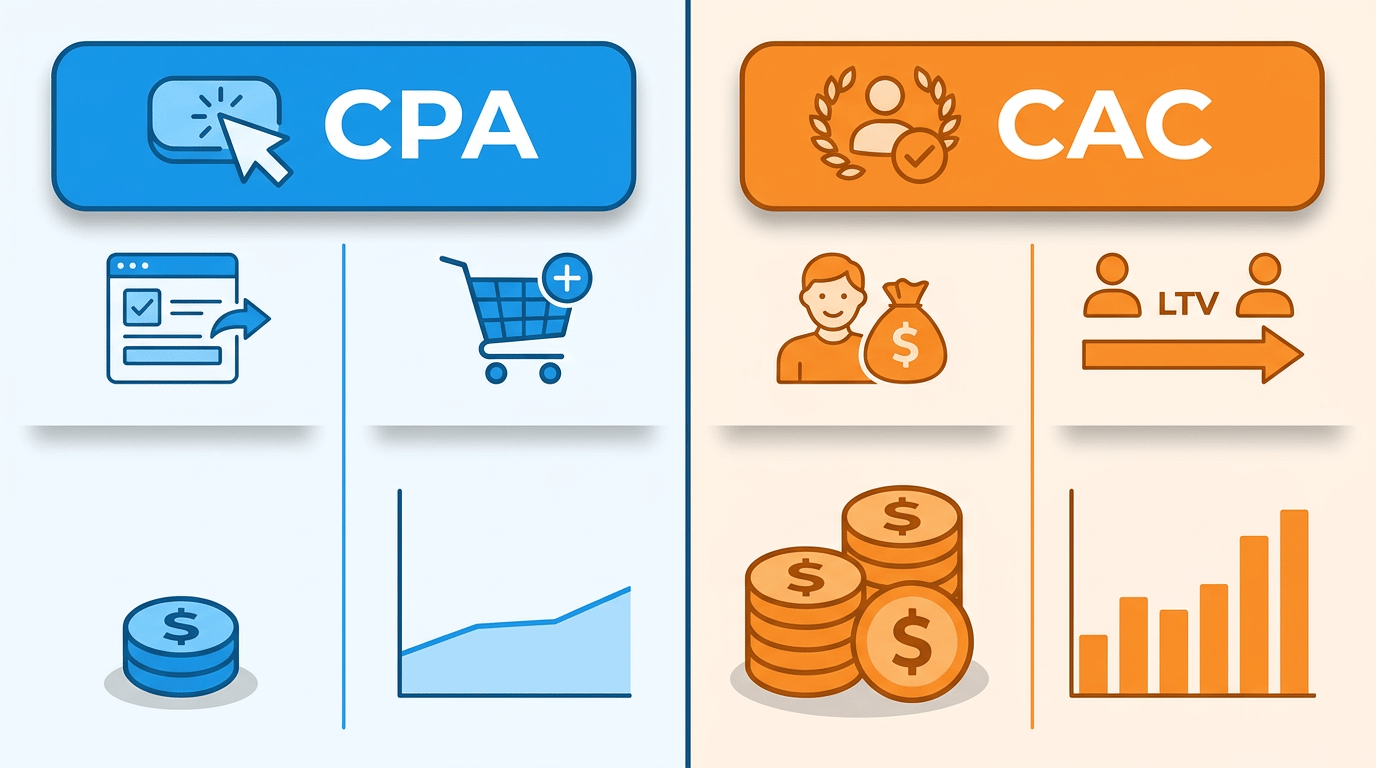
Both "CAC" and "CPA" are indicators that express "the cost incurred to acquire a customer," and because their names are similar, they tend to get confused. However, the two clearly differ in "what is included in the cost" and "in which situations they are used." This article organizes the definition and calculation method of CAC and CPA respectively, and then the differences between the two and how to use each.
What is CAC? The "customer acquisition cost" of the whole business
CAC stands for "Customer Acquisition Cost." It represents the total cost incurred to acquire one new customer, and is especially valued as an indicator for measuring the health of SaaS and subscription-type businesses.
The biggest characteristic of CAC is that it includes "all costs" incurred in customer acquisition. Beyond ad costs, of course, it is calculated to include the personnel costs of the sales and marketing departments, the costs of running offline events, and in some cases even outsourcing fees and tool usage fees. In other words, you can grasp the "true cost" of acquiring customers across the whole business.
How to calculate CAC
CAC is calculated as "total cost incurred in customer acquisition / number of new customers acquired." For example, if you spend a total of 10 million yen on marketing and sales activities in a given period and acquire 500 new customers, the CAC is 20,000 yen.
What is CPA? The "cost per result" of a web ad campaign
CPA stands for "Cost Per Acquisition" and is an indicator used mainly in the field of web advertising. It refers to the cost incurred per conversion (purchase, registration, etc.) generated via an ad.
CPA basically takes "ad cost" as its denominator. It does not include personnel costs or indirect expenses; it is used purely to evaluate how efficiently a specific ad campaign generated results. It is an indicator that appears frequently on the front lines of digital advertising, such as listing ads and SNS ads.
How to calculate CPA
CPA is calculated as "ad cost / number of conversions." For example, if you spend 500,000 yen in ad cost and obtain 100 conversions, the CPA is 5,000 yen. The form of the formula resembles CAC, but the point is that the range included in the numerator (cost) is narrow.
Organizing the difference between CAC and CPA
The difference between the two can mainly be summarized into two points: the "range of cost" and the "situation in which they are used."
- Range of cost: CAC is the "total cost of customer acquisition" including personnel and indirect costs. CPA is mainly "ad cost only"
- Situation of use: CAC is at the whole-business or channel level. CPA is at the individual ad campaign level
- Target users: CAC also covers acquisition outside ads, such as organic traffic. CPA centers on results via ads
Put simply, it is easier to understand if you organize them as: CPA is the micro indicator for seeing "is this ad efficient," and CAC is the macro indicator for seeing "is the business spending too much on customer acquisition." Because CAC captures cost more broadly, it produces figures closer to the actual state of the business.
How to use them: choose according to your purpose
CAC and CPA are used differently according to the range of the measure for which you want to perform cost analysis and effectiveness verification.
CPA if you want to improve ad campaigns
When you want to determine "which ad medium is producing results" or "which campaign is efficient," use CPA as your indicator. It suits comparison and optimization on a per-campaign basis, and is the indicator used most frequently in day-to-day operational improvement.
CAC if you want to see the profitability of the business
When you want to see "whether the business as a whole is spending too much on customer acquisition," use CAC as your indicator. It is an indispensable indicator for reporting to management and investors, and for judging mid- to long-term business growth.
The relationship between LTV and "unit economics," which makes use of CAC
The biggest purpose of calculating CAC lies in grasping "unit economics," which represents the profitability of the business. This compares customer lifetime value (LTV) with CAC, and is calculated as "LTV / CAC."
Generally, a state where LTV is at least 3 times CAC—that is, where this value is 3 or more—is considered desirable. It checks whether the profit obtained from one customer over their lifetime sufficiently exceeds the cost of acquiring that customer. This kind of business-health judgment is difficult with CPA, which looks only at ad costs, and becomes possible precisely with CAC, which includes all costs.
Summary: use both indicators together and switch perspectives
CPA, as "ad cost / number of conversions," measures the efficiency of an individual ad campaign, while CAC, as "total cost of customer acquisition / number of new customers," measures the profitability of the whole business. It is not about which is superior, but about using them differently according to the range you want to see.
In day-to-day ad operations, refine campaigns finely with CPA, and from a management perspective, check the health of the business with the balance of CAC and LTV—using these two perspectives together is the first step toward efficient and sustainable customer acquisition. First, clarify "which range of cost your company wants to measure," and try choosing the appropriate indicator.