What Is a Business Forecast? Forecasts vs. Budgets and Targets
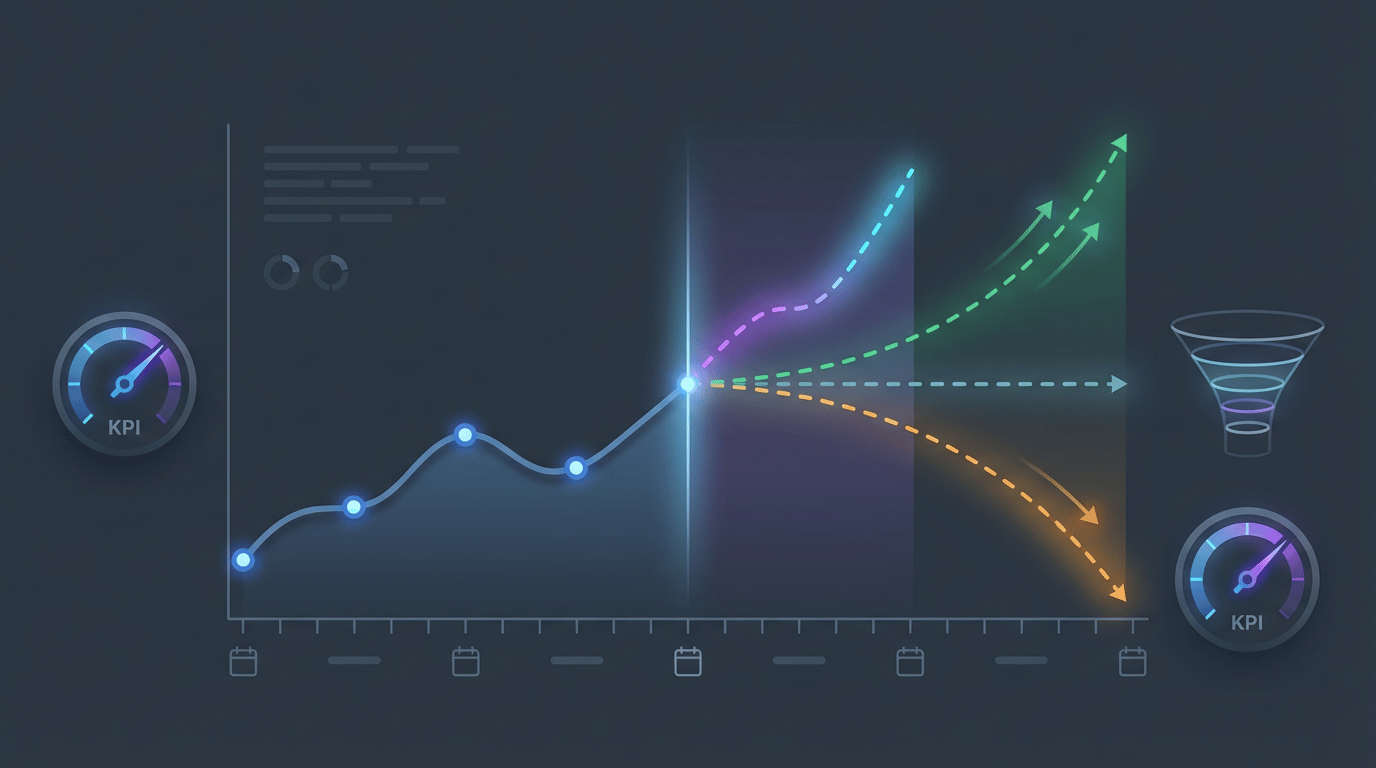
A business forecast estimates future performance using currently available information and assumptions. A target states what the organization wants to achieve; a budget is an approved plan; a forecast describes where the business appears likely to finish under current conditions. Do not raise a forecast merely to match the target.
First fix the measure, horizon, currency and as-of date. This quarter’s bookings, this month’s recognized revenue and next month’s cash receipts require different inputs.
Compare the terms
Term | Meaning | Update rule |
|---|---|---|
Target | Desired outcome | Record the business reason for a change |
Budget | Approved revenue or spending plan | Retain original and revised versions |
Actual | Confirmed result | Distinguish pending items, cancellations and corrections |
Forecast | Current estimate of the eventual result | Update while preserving assumptions and versions |
A forecast below target is not automatically a reporting failure. It can reveal the need for sales support, cost adjustments or capacity changes. Hiding the gap with optimistic assumptions delays those decisions.
Add closed actuals to the remaining forecast
Suppose a fictional quarter has ¥3,000,000 of confirmed first-month revenue. The second month is forecast at ¥3,500,000 and the third at ¥4,000,000. The quarterly outlook is ¥10,500,000, leaving a ¥1,500,000 gap to a ¥12,000,000 target.
Month | Confirmed actual | Remaining-period estimate | Amount used |
|---|---|---|---|
Month 1 | ¥3,000,000 | Not applicable | ¥3,000,000 |
Month 2 | Not closed | ¥3,500,000 | ¥3,500,000 |
Month 3 | Not closed | ¥4,000,000 | ¥4,000,000 |
Quarter | ¥3,000,000 | ¥7,500,000 | ¥10,500,000 |
If part of month two becomes actual, remove it from the remaining estimate. Otherwise the same transaction appears twice. Simply multiplying a partial month’s result can also ignore seasonality or month-end concentration.
Keep bookings, revenue and cash separate
Measure | Timing represented | Fictional example |
|---|---|---|
Bookings | Contract agreement | A ¥1,200,000 annual agreement signed in October |
Revenue recognition | Delivery and the applicable accounting policy | Assumed even delivery at ¥100,000 per month |
Cash receipts | Payment received | Contract specifies ¥1,200,000 paid in November |
The revenue treatment is an illustrative assumption. Actual accounting depends on the contract and performance obligations. More bookings do not automatically mean the same increase in current-month revenue or cash. Place payment and collection schedules beside any proposed marketing investment.
Use scenarios with explicit conditions
Hold first-month actual revenue at ¥3,000,000 and vary the remaining two months.
Scenario | Month 2 | Month 3 | Quarter | Assumption |
|---|---|---|---|---|
Downside | ¥3,000,000 | ¥3,200,000 | ¥9,200,000 | A major delivery start slips into the next quarter |
Base | ¥3,500,000 | ¥4,000,000 | ¥10,500,000 | Current opportunity and delivery plans proceed |
Upside | ¥4,000,000 | ¥4,800,000 | ¥11,800,000 | Additional sales and delivery capacity both materialize |
An upside case needs conditions and owners, not only enthusiasm. Do not assume that 20% more advertising produces 20% more revenue. Demand, acquisition efficiency, sales capacity and recognition timing can constrain the result. Show the impact of a major dependent deal separately.
Preserve the evidence behind the number
Inputs can include contracted delivery, renewals, open opportunities and repeatable sales patterns. Separate relatively firm amounts from assumption-heavy ones and attach the source, confirmation date and owner. Missing data should not silently become zero.
Forecasting: Principles and Practice emphasizes evaluating genuine forecasts on outcomes not already known when the forecast was made. In an operating process, this means saving the as-of version rather than overwriting history after the result arrives.
Start with one repeatable process
- Choose one measure and horizon.
- Close actuals and remove overlap with remaining estimates.
- Record the base case and main uncertainties.
- Explain the gap to target by amount, timing or volume.
- Assign the next action and update date, retaining the forecast version.
The companion forecast-management guide covers deal probabilities, weekly reviews and accuracy checks. Begin with a table another person can recalculate using the same definitions and period.
Related practical guides
- Forecast Management: Deal Probabilities, Weekly Reviews, and Accuracy Checks
- Marketing Budget Allocation: Scenario Planning and Reallocation Decisions
- Management Accounting for Marketing: Campaign P&L and Break-Even Analysis
Keep execution and budgets connected
Xtrategy supports project management, monthly budgets and actuals, and customer and deal records. Review its features to decide how your owners, costs and review dates fit the workflow, then get started.