Complete List of Marketing Tactics | Effective Online & Offline Strategies Explained
Shusaku Yosa
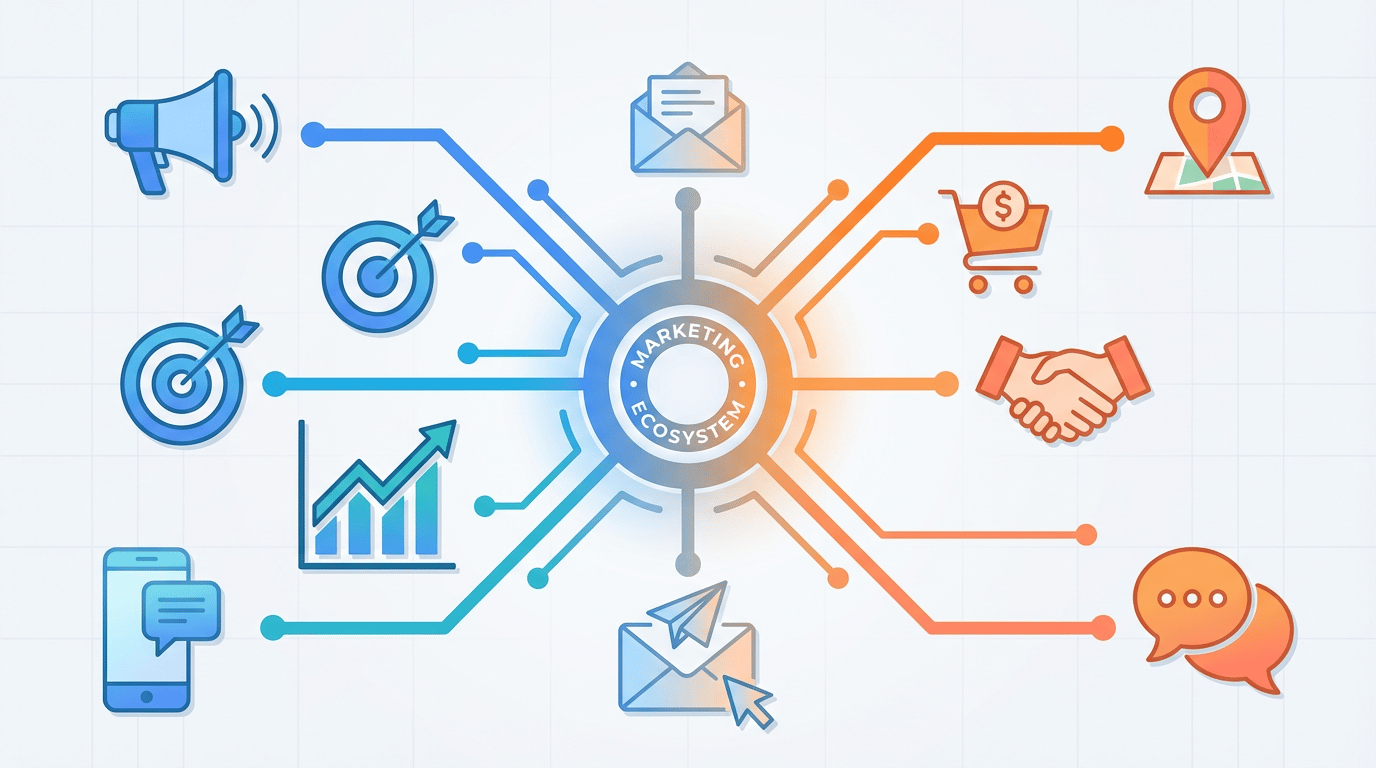
"I want to boost customer acquisition, but I don't know where to start." "There are too many tactics to choose from and I can't prioritize." — If you're a marketing professional, chances are you've hit this wall at some point.
Marketing tactics broadly fall into two categories: online and offline. Understanding the characteristics of each and selecting the right tactics for your business stage is the shortest path to results.
This article provides a comprehensive list of major marketing tactics organized by online and offline channels, along with category classification frameworks, prioritization methods, and performance measurement techniques.
What Are Marketing Tactics? Fundamental Concepts
Marketing tactics are the specific actions executed to achieve business growth objectives. From market research and strategy development to customer acquisition, lead generation, nurturing, purchase conversion, and loyalty building — selecting and executing the optimal tactics at each stage of the marketing process is essential.
The key to choosing tactics lies in the fundamental design question: "Who are we reaching, what are we offering, and how are we delivering it?" Define your customer profile through persona development and customer journey mapping, then assign roles to each tactic accordingly.
Online Marketing Tactics
Online tactics leveraging digital technology offer the advantage of easy performance measurement and rapid PDCA cycles. Here we organize the key tactics by funnel stage.
SEO (Search Engine Optimization)
SEO is the practice of ranking your website and content higher in search results to drive organic traffic. It requires keyword-driven content design, internal link optimization, and strengthening E-E-A-T (Experience, Expertise, Authoritativeness, Trustworthiness). While results may take several months, once established, SEO builds a sustainable acquisition channel without ongoing ad spend — making it a valuable long-term asset.
Content Marketing
Content marketing involves consistently publishing valuable information — blog posts, white papers, videos, infographics — to build trust with prospects and guide them toward purchase. When integrated with SEO, it creates an end-to-end system from search traffic to lead generation. While AI-powered content creation has improved efficiency, differentiation through unique expertise and firsthand experience has become more important than ever.
Digital Advertising (Search, Display & Social Ads)
Search ads reach high-intent users and deliver quick results. Display and social ads are effective for awareness and branding. AI-driven creative optimization and improved audience targeting have significantly boosted operational efficiency. However, with strengthening cookie restrictions, the shift toward first-party data utilization and contextual targeting is accelerating.
Social Media Marketing
Social media marketing uses platforms like X (formerly Twitter), Instagram, LinkedIn, TikTok, and YouTube for content distribution and community building. For B2C, short-form video on Instagram and TikTok drives awareness; for B2B, thought leadership on LinkedIn and X is highly effective. UGC-driven word-of-mouth campaigns and creator collaborations for brand awareness are also gaining significant traction.
Email Marketing
Email marketing nurtures leads through purpose-driven campaigns including drip sequences, segmented emails, and win-back campaigns. Marketing automation tools enable automated delivery timing based on behavioral data and personalized content delivery. It remains one of the most cost-effective tactics with consistently high ROI.
Video Marketing
Video marketing encompasses product demos, webinars, how-to videos, and customer testimonials. It communicates product value intuitively where text alone falls short, while also improving website dwell time and SEO performance. In B2B, sending pre-meeting sales videos has become a popular approach to reduce meeting time while improving prospect understanding.
Webinars & Online Seminars
Online seminars attract participants regardless of location, making them effective for both lead generation and nurturing. Live sessions enable interactive communication, while recordings can be repurposed as on-demand content for long-term lead generation.
Marketing Automation (MA)
MA collects and analyzes prospect behavioral data to automatically deliver the right content at the right time. It enables lead scoring for optimized sales handoff criteria and automated nurturing through scenario design. MA tools have become an essential foundation for strengthening marketing-sales alignment.
Offline Marketing Tactics
Even in today's digital-first world, offline tactics leveraging face-to-face interactions continue to deliver strong results. Their strengths are particularly evident for B2B high-ticket products and experience-driven B2C offerings.
Trade Shows & Conferences
Exhibiting at industry trade shows and conferences creates direct access to key decision-makers. On-site demos and consultations accelerate the path to deal creation. Importing captured lead data into your MA tool and connecting it with online follow-up campaigns maximizes outcomes.
Seminars & Workshops
Hosting your own seminars and industry workshops generates leads while demonstrating expertise. Direct audience interaction provides high-quality insights that inform subsequent sales activities. Relationships built offline tend to produce higher LTV compared to online-only approaches.
Direct Mail (DM)
Physical direct mail has been reevaluated as an attention-grabbing channel amid digital ad saturation. In B2B, it's particularly effective for reaching decision-makers directly. Combining DM with QR codes and personalized URLs creates a bridge to online campaigns.
Transit & OOH (Out-of-Home) Advertising
OOH advertising — including transit ads, station signage, and billboards — targets awareness and branding. It's also effective for geographically targeted campaigns and can be amplified through integration with digital campaigns. The rise of digital signage has improved flexibility for time-based and audience-specific messaging.
PR & Press Releases
Press releases distribute official company news to media outlets. Using distribution services enables syndication across web media outlets, generating backlinks (SEO value). Media coverage provides third-party credibility that advertising alone cannot achieve, building social proof and brand trust.
Telemarketing & Inside Sales
Phone and video-based outreach is a critical lead nurturing channel in B2B. Integrating MA scoring data enables precise timing for engaging high-priority leads. Weekly data sharing between marketing and sales teams, with continuous optimization of meeting conversion rates, is key to success.
Categorizing Marketing Tactics
To manage tactics effectively, proper categorization and a bird's-eye view of the landscape are essential. Here are three practical classification frameworks.
By Funnel Stage
Map tactics to each stage of the marketing funnel. Awareness stage: social ads, PR, OOH. Interest stage: SEO, content marketing. Consideration stage: webinars, case studies. Purchase stage: retargeting ads, inside sales. Retention stage: email marketing, loyalty programs. Identify where your funnel has bottlenecks and invest heavily in those areas.
By Channel Type (PESO Model)
The PESO model classifies tactics across Paid (advertising), Earned (PR/word-of-mouth), Shared (social sharing), and Owned (company media). Paid delivers quick results but costs more; Owned builds long-term assets but takes time. Earned provides high credibility but is hard to control; Shared offers virality but requires reputation management. Optimizing the balance across all four maximizes overall marketing ROI.
By Time Horizon
Classify tactics as short-term (1-3 months to results) or long-term (6+ months). Short-term includes paid ads and campaigns; long-term includes SEO, branding, and content marketing. When planning quarterly budgets, balance short-term revenue maintenance with long-term growth foundation building.
How to Prioritize Marketing Tactics
With limited budget and resources, focused investment based on clear priorities is essential. Follow these four steps to set your priorities.
Step 1: Define Business Goals and KGIs
Start by defining the ultimate goal (KGI) of your marketing activities. Is it revenue growth, new customer acquisition, or improving existing customer LTV? Without clear business objectives, there's no basis for evaluating tactics.
Step 2: Score Tactics Using the ICE Framework
Rate each tactic on three axes — Impact (expected magnitude of results), Confidence (certainty of success), and Ease (simplicity of execution) — on a scale of 1-10. Rank by total score. Using historical performance data and industry benchmarks as evidence eliminates subjective bias and facilitates team alignment.
Step 3: Factor in Resource and Budget Constraints
Even high-ICE tactics may not be feasible if your team lacks the expertise or required tools. Audit your available resources (talent, tools, partners) and budget, then realistically assess execution feasibility. Design budget allocation based on deal value and LTV rather than lead volume for better ROI.
Step 4: Build a Short-Term / Long-Term Portfolio
Once priorities are set, design a balanced portfolio combining quick-win revenue tactics with long-term asset-building strategies. A common approach pairs search ads for immediate acquisition with SEO and content marketing for future CPA reduction. Review results quarterly and adjust the portfolio ratio accordingly.
Measuring Marketing Tactic Effectiveness
Execution alone doesn't drive results. Running improvement cycles through measurement is the most critical process in marketing success.
KPIs by Tactic
The first step is assigning KPIs to each tactic. For SEO: search rankings, organic traffic, CTR. For paid ads: CPA, ROAS, conversion rate. For email: open rate, click rate, unsubscribe rate. For social: engagement rate, reach, follower growth. The key is clarifying how these KPIs connect to your ultimate KGI (revenue, profit, LTV).
The Importance of Attribution Analysis
With customers touching multiple channels before purchase, last-touch attribution alone misrepresents true tactic contribution. Use multiple models — first-touch, linear, time-decay, and data-driven — to evaluate each tactic's contribution across the full customer journey. Understanding cross-channel interactions enables optimized budget allocation.
Dashboard Visualization and Regular Reviews
For measurement to function organizationally, visualize KPIs in real-time using BI tools or marketing dashboards, and establish regular review meetings. When marketing and sales share the same data and review performance weekly, early problem detection and course correction become possible. Building a data-driven decision-making culture is the key to sustained results.
Marketing Trends to Watch in 2026
Finally, here are three key marketing trends gaining momentum in 2026.
First, AI-powered hyper-personalization. By analyzing zero-party and first-party data with AI, real-time contextual messaging tailored to individual behavior is now possible. With cookie restrictions tightening, companies are investing heavily in first-party data infrastructure and conversational AI for data collection.
Second, full-funnel integrated marketing. Rather than optimizing individual channels in isolation, the holistic design and measurement of the entire customer journey — from awareness through purchase and repeat — is becoming mainstream. Building cross-channel measurement infrastructure and visualizing inter-tactic synergies is the key to success.
Third, live commerce and shoppable content. The fusion of entertainment and shopping experiences is accelerating, with viewers able to purchase products directly during live streams and interactive videos. This tactic is gaining particular attention in B2C for converting viewers into buyers at the moment of peak engagement.
Conclusion
Knowing about marketing tactics isn't enough — results require selecting the right ones for your goals, customers, and resources. Classify tactics by funnel stage, channel type, and time horizon, then use frameworks like ICE scoring to establish clear priorities.
After execution, track KPIs and conduct attribution analysis to validate effectiveness, then continuously run data-driven improvement cycles. This forms the foundation for sustained growth.
Building an organization that can manage tactics holistically across online and offline channels — with full-funnel integration — will be the source of competitive advantage in 2026 marketing.