What Is Omnichannel Strategy? Difference from Multichannel and Implementation
Shusaku Yosa
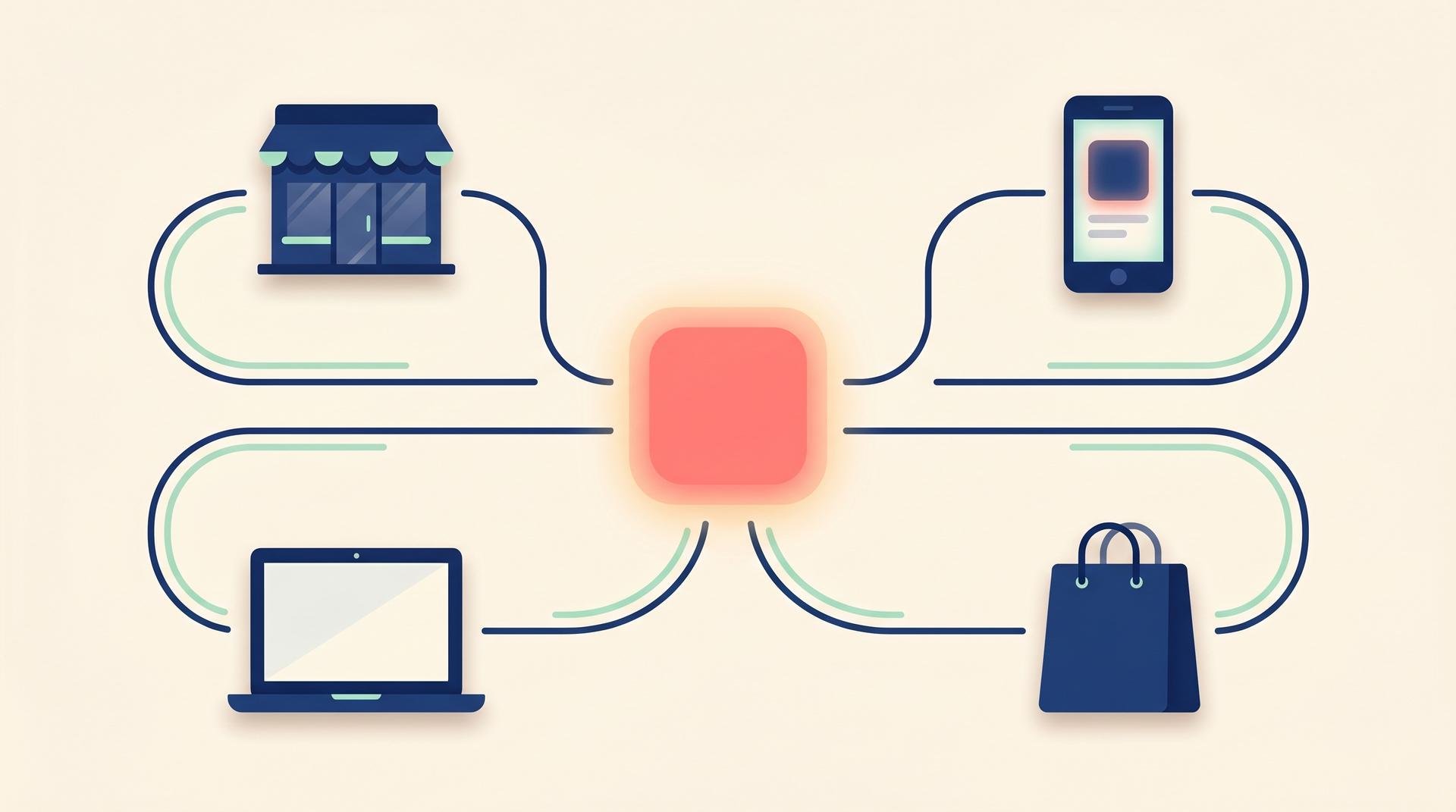
"We have physical stores and an e-commerce site, but they operate separately and the customer experience isn't connected"—the way of thinking drawing attention as a solution to this challenge is omnichannel strategy. With the spread of smartphones, customers now move freely among stores, e-commerce, apps, and social media as they decide on purchases. This article organizes, from a practical standpoint, the meaning of omnichannel strategy and why it's gaining attention, how it differs from the easily confused multichannel, cross-channel, O2O, and OMO, its benefits and challenges, and the five implementation steps along with representative success stories.
What Is Omnichannel Strategy?
Omnichannel strategy is a strategy that integrates every touchpoint (channel) connecting a company and its customers—physical stores, e-commerce sites, apps, social media, call centers, and more—so that customers can obtain a consistent purchasing experience no matter which channel they go through. "Omni" is a prefix from Latin meaning "all," expressing the idea of "integrating all channels."
Its greatest feature lies in aiming to make customers "unaware of channel differences." For example, ordering a product seen in a store on the spot via an app and receiving it at home, or picking up a product purchased online at the nearest store—it provides a seamless experience that erases the boundary between online and offline. What underpins this is a mechanism that centrally manages customer data and inventory information on a single platform.
Why Omnichannel Strategy Is Gaining Attention
Behind the growing importance of omnichannel lies a major change in consumer behavior.
- The spread of smartphones: Customers now move back and forth between online and offline even in the middle of shopping—checking reviews or comparing prices while looking at a product in-store.
- Diversifying purchasing behavior: Purchase paths are growing more complex, with "showrooming" (trying in-store and buying via e-commerce) and "webrooming" (researching on social media or reviews before visiting a store).
- Lost opportunities from channel fragmentation: Missing a sale because a store has no stock, or being unable to point to store inventory when e-commerce is out of stock—such fragmentation becomes the very risk of handing customers to competitors.
Difference from Multichannel
What is most easily confused with omnichannel is "multichannel." Multichannel refers to a strategy of having multiple sales channels—physical stores, e-commerce, catalogs, social media, and so on—but the decisive difference lies in the fact that each channel is operated independently.
In multichannel, even if a store is out of stock, that information is not reflected in e-commerce, and customer information and purchase history are fragmented by channel. Customers have multiple options, but experiences across channels don't connect. By contrast, omnichannel integrates those multiple channels and centralizes inventory and customer data, realizing a state where the same experience is possible no matter where you enter. In other words, while multichannel emphasizes "providing multiple options," omnichannel differs essentially in aiming for the "creation of a seamless customer experience."
Difference from Cross-channel, O2O, and OMO
Beyond multichannel, there are other easily confused related terms. Let's organize them by the degree of channel integration and the goal of the strategy.
- Cross-channel: A stage that advances multichannel a step further by partially linking inventory, order information, and the like. "Order via e-commerce and pick up at a store" is a representative example, but customer data is not yet fully integrated. It is positioned as the stage just before omnichannel.
- O2O (Online to Offline): Measures that drive store visits from online. Promoting visits with app coupons is typical, and it differs from the bidirectional omnichannel in that the direction is fixed "from online to offline."
- OMO (Online Merges with Offline): A newer concept that fuses online and offline without distinguishing between them in the first place. Whereas omnichannel focuses on "integrating channels," OMO pursues the fusion of the customer experience itself more deeply.
Benefits of Omnichannel Strategy
Integrating channels generates the following benefits for both customers and the company.
- Improved customer satisfaction and loyalty: Because customers can get a consistent experience at their preferred timing and channel, their trust in and attachment to the brand grows.
- Reduced lost sales opportunities: By linking inventory and order data, responses like "point to e-commerce stock because the store has none" become possible, preventing lost opportunities.
- Centralized use of customer data: Because behavioral data from every touchpoint can be integrated, the precision of proposals and marketing tailored to each individual customer improves.
- Maximizing LTV (customer lifetime value): By building a relationship that keeps getting chosen, repeat purchases and customer spend grow, leading to long-term revenue.
Implementation Challenges and Cautions
On the other hand, realizing omnichannel also involves challenges to overcome.
- Cost and complexity of system integration: Integrating inventory, customer, and order data requires linking core systems and e-commerce platforms, demanding corresponding investment and design.
- Breaking down departmental silos: If store, e-commerce, and marketing operate under separate goals, integration won't progress. A review of organization and evaluation systems comes with it.
- Designing company-wide common KPIs: Pitting channels against each other on sales hinders integration. A shift to metrics tracked company-wide, such as LTV, is necessary.
- A medium-to-long-term effort: It isn't something completed all at once; an attitude of growing it in stages while running the PDCA cycle is essential.
Steps to Implement Omnichannel Strategy
Omnichannel tends to stall if you try to integrate all channels at once. It is realistic to proceed in stages from a small start, in the following order.
- Inventory of channels and identifying priority paths: List out the customer touchpoints your company has, draw a customer journey, and decide "which path to connect first."
- Centralizing customer IDs and inventory: Unify member IDs and make it possible to manage inventory and purchase history on a single platform. This is the heart of omnichannel.
- Setting company-wide common KPIs: Rather than channel-by-channel sales, share metrics that measure the results of integration—such as LTV and customer satisfaction—across the company.
- Selecting the platform and tools: Choose tools that support data integration, such as an e-commerce platform, CRM, and apps with flexible API connectivity.
- Small start and phased expansion: Begin with high-priority paths, and expand the target channels and measures while verifying effectiveness.
Omnichannel Strategy Success Stories
To get a concrete picture, let's look at some representative success stories.
MUJI (MUJI passport)
Ryohin Keikaku's MUJI is known as a pioneer of omnichannel. At its core is the app "MUJI passport," which functions as a digital membership card and manages purchase history and mileage spanning stores and e-commerce in common. It also features store inventory checks, a check-in function, and more, serving as the central tool that integrates customer touchpoints through the app.
Yodobashi Camera
Electronics retailer Yodobashi Camera unified prices and return methods between its stores and its e-commerce "Yodobashi.com," creating an experience where users can shop under the same conditions on either. Its stance of operating stores and online as one rather than pitting them against each other is praised as a representative success story in the industry.
Starbucks
Starbucks offers "Mobile Order," where you complete ordering and payment via a mobile app and pick up at a store, and made its loyalty program usable in common online and in stores. Centered on the app, it is a fine example of realizing a consistent experience from ordering to rewards.
Summary
Omnichannel strategy is a strategy that integrates every customer touchpoint so customers can obtain a consistent experience without being aware of channel differences. Unlike multichannel, which merely holds multiple channels in parallel, its essence lies in moving customer data and inventory on a single platform. For implementation, the path to avoid failure is to proceed in the flow of inventorying channels and identifying priority paths, centralizing customer IDs and inventory, setting company-wide common KPIs, selecting platform tools, and expanding in phases from a small start. As the MUJI and Yodobashi Camera examples show, the key is a shift in thinking from "product-centric" to "customer-centric." Start by mapping how your own customers move among multiple channels, and take the first step toward integration.