What Is the PDCA Cycle? Four Steps, Example, and Review Pitfalls
Shusaku Yosa
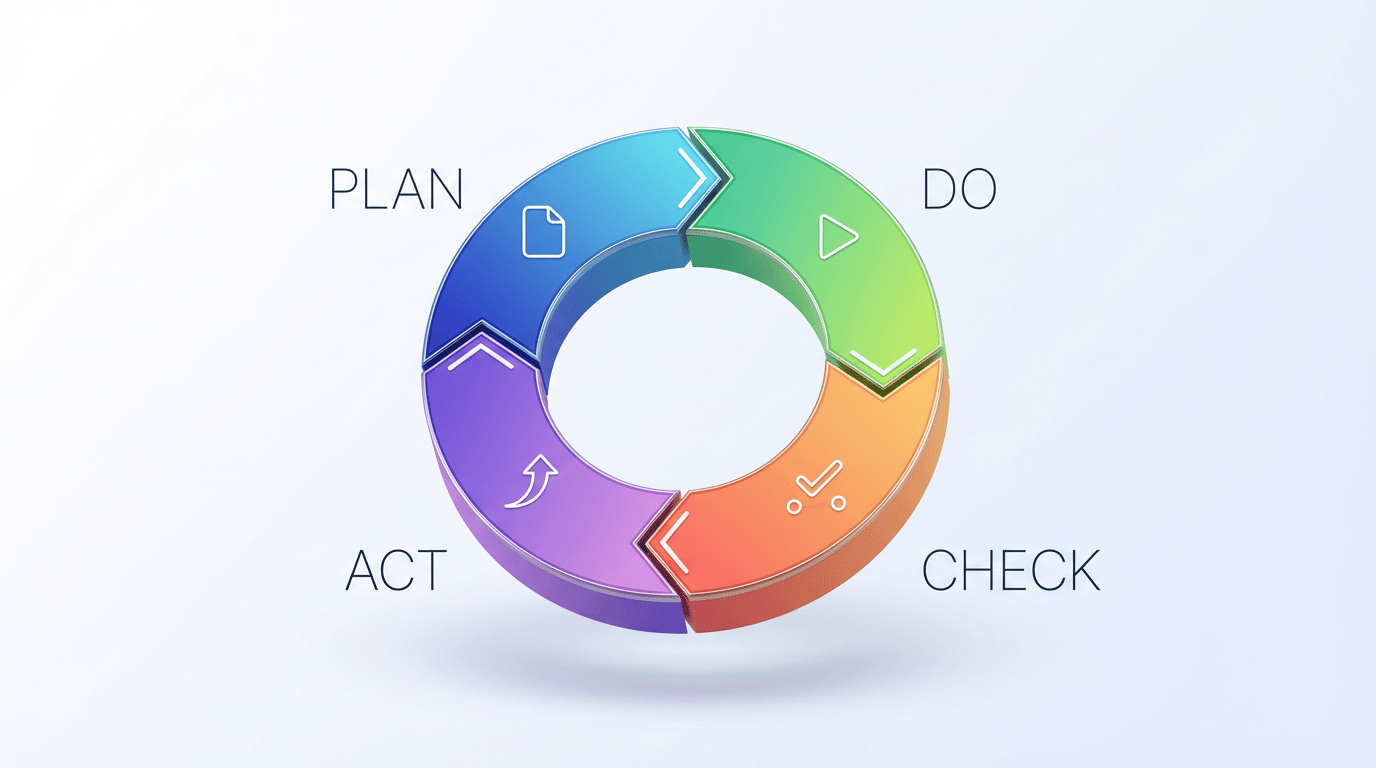
PDCA means Plan, Do, Check, and Act: a repeating process for planning a change, testing it, reviewing evidence, and deciding what to do next. Its value comes from connecting decisions to records, not from holding more meetings.
The American Society for Quality describes PDCA as an iterative approach involving small-scale testing and learning. Using the framework alone does not guarantee improvement. Each cycle should make clear what was observed and what remains uncertain.
The four PDCA steps
Step | Work | Record |
|---|---|---|
Plan | Define the problem, hypothesis, change, and evaluation | Baseline, success criteria, period, owner |
Do | Run the agreed test and check execution | Dates, exposure, defects, exceptions |
Check | Compare results under the agreed conditions | Counts, data quality, explanations, limits |
Act | Maintain, investigate, revise, or stop | Next action, owner, check date |
Plan narrows a broad ambition into a testable question. Do records whether the intended change actually reached its audience. Check separates a difference in the numbers from confidence in its explanation. Act turns that assessment into the next specific task.
A copyable one-page worksheet
Field | Entry |
|---|---|
Problem and baseline | [Audience, period, denominator, current state] |
Hypothesis and change | [Expected mechanism; exact change] |
Population and comparison | [Groups, allocation, exclusions] |
Period and measures | [Dates, outcome delay, quality safeguards] |
Observations and limits | [Counts, rates, gaps, external factors] |
Decision and responsibility | [Maintain, investigate, revise, stop; owner and deadline] |
Leave unknown information explicitly unverified. Assign a way to investigate it rather than filling a blank with an attractive assumption.
A hypothetical example: changing one CTA label
This fictional example is not a reported experiment or business result. A service site tests changing “Contact us” to “Send your question,” hypothesizing that the new label makes the action clearer. The form, price, and advertising copy stay unchanged.
Plan and Do
Assume eligible browsers are randomly assigned to A or B concurrently, with a stable assignment throughout the test. The unit is a deduplicated assigned browser, not necessarily a person. Staff and known test environments are excluded under predefined rules.
The plan runs for two weeks, followed by one week for inquiry qualification. The primary measure is browsers with a valid inquiry divided by assigned browsers. Qualification excludes duplicates and sales solicitations. The team checks exposure, clicks, successful submissions, and qualification records before starting, and avoids changing the end date after inspecting results.
Check
Fictional observation | A: original label | B: revised label |
|---|---|---|
Assigned browsers | 1,000 | 1,000 |
Browsers with a CTA click | 100 | 125 |
Browsers with a valid inquiry | 15 | 20 |
Valid inquiry rate | 1.5% | 2.0% |
The observed difference is 0.5 percentage points. This table does not establish statistical significance, repeatability, or future revenue. Sample requirements, allocation imbalance, missing data, cross-browser use, and inconsistent qualification still matter. Microsoft Research's online experimentation work addresses the design needed for causal evaluation.
Act
A reasonable decision is further validation rather than announcing a proven winner. The operations owner checks measurement, sales reviews qualification consistency, and the next meeting approves a suitable follow-up design and observation period. This produces an actionable next Plan.
Separate observations, explanations, and uncertainty
“Results increased after the change” is an observation. “The change caused the increase” is a stronger claim. Before-and-after comparisons can also reflect seasonality, traffic mix, prices, competition, or measurement changes. Limiting changes makes learning easier; it does not independently prove causation.
If an SEO rewrite changes examples, headings, and links together, a ranking improvement cannot isolate the contribution of examples. No movement after a month does not prove an intent mismatch either. Investigate queries, displayed URLs, timing, and crawl status using the Search Console guide.
Similarly, testing new ad copy and a new landing page evaluates the combination. Unchanged CTR does not isolate the landing page's effect. Email opens need caution because Apple's privacy protection can load remote content in the background. Check clicks and valid outcomes too.
Separate meeting cadence from outcome timing
A weekly meeting can check execution and defects while a sales outcome needs months to mature. Evaluation timing should follow the required observations and outcome delay. PDCA is neither exclusively long-term nor automatically better when rushed.
Use our KPI guide to define measures and marketing PDCA guide for operating detail. For coordinating project workflows and KPIs, explore Xtrategy's features.