Issue Log Template: Examples, Due Dates, Updates, and Resolution Checks
Shusaku Yosa
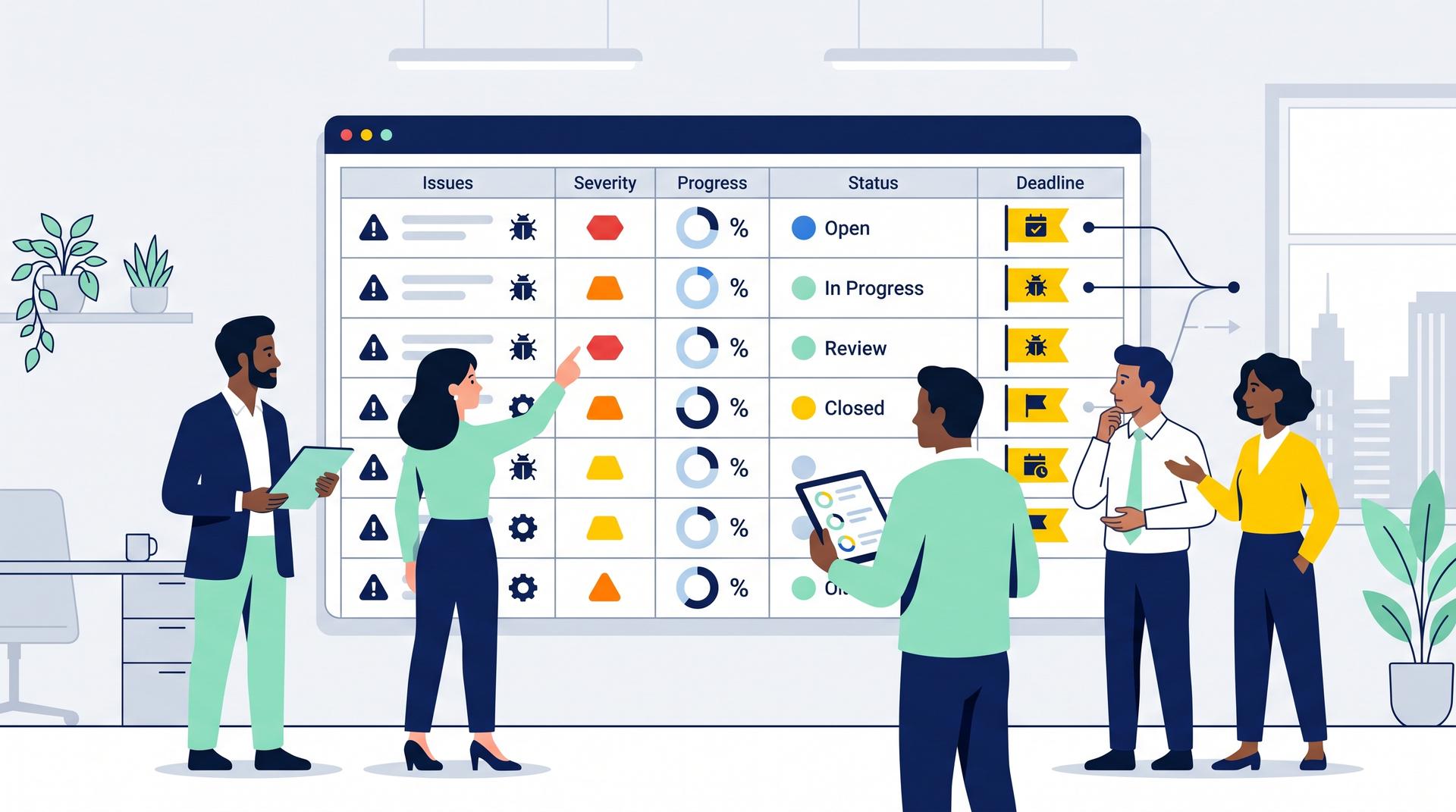
An issue log tracks current problems and decisions through impact, next action, owner, due date, and resolution checks. A list of concerns is insufficient: the record should show who acts next and what would demonstrate that the issue has been addressed.
The tables below are a copyable starting point. Situations, people, and dates are fictional rather than reports of real incidents. Set severity and escalation rules for the business impact and decision rights in your organization.
What an issue log tracks, and how it connects to tasks and risks
This guide uses “issue” for an existing discrepancy or pending decision, “task” for work to perform, and “risk” for an uncertain future event. Organizations use different terminology, so agree your meanings first. An issue may have a known solution, and a task may require investigation. An unknown answer is not the only reason to log an issue.
Record | Fictional example | Connection |
|---|---|---|
Issue | Image usage conditions remain unclear, preventing a publication decision | Record the investigation and decision owner |
Task | Ask the provider about permitted media | Reference the issue and track its owner and due date |
Risk | Additional revisions might leave insufficient review time | Review the trigger and possible response |
The Northern Ireland Department of Finance’s issue management guidance discusses recording, assessing, assigning, addressing, and escalating issues. Different problems need different responses. A separate file is optional: a filtered view of an existing work register may be sufficient. Check missing deliverables against the WBS completion conditions.
A copyable issue log with three worked examples
Use row 1 for headings and columns A through O as below. The formulas depend on those column positions; update them if you rearrange fields. H contains the approach and immediate next action, while I names the person who owns that action.
Columns | Fields | Entry rule |
|---|---|---|
A–D | ID / raised date / reporter / type | Keep the ID and record when the facts became known |
E–G | Situation / impact / severity | Separate observation from interpretation |
H–J | Approach and next action / owner / action due | Name the action, person, and deadline |
K–L | Status / resolution | Agree status terms and exit conditions |
M–O | Last meaningful update / verifier / evidence and task ID | Record substantive progress and its reference |
A:ID | B:Raised | C:Reporter | D:Type | E:Situation | F:Impact | G:Severity | H:Approach / next action | I:Owner | J:Action due | K:Status | L:Resolution | M:Last meaningful update | N:Verifier | O:Evidence / task |
|---|---|---|---|---|---|---|---|---|---|---|---|---|---|---|
I-01 | 2026-10-07 | A | Rights clarification | Permitted image media unclear | Publication decision waiting | High | Ask provider about media and period | B | 2026-10-12 | In progress | 2026-10-09 | Editorial lead | T-11 / usage conditions | |
I-02 | 2026-10-08 | C | Scope change | Quote and brief differ on revision rounds | Cost and date need agreement | Medium | Compare documents and present options | D | 2026-10-13 | Awaiting decision | 2026-10-10 | Project owner | T-12 / quote v2, brief v3 | |
I-03 | 2026-10-09 | A | Duplicate | Same image enquiry as I-01 | Duplicate effort | Low | Merge into I-01 and inform reporter | B | 2026-10-09 | Duplicate | Continue original I-01 | 2026-10-09 | Editorial lead | I-01 / merge record |
Rather than deleting a duplicate, retain its original reference and merge reason so enquiries can be traced. Store sensitive contractual or personal detail where access is restricted; the shared list needs only the information required for coordination.
Writing the situation, impact, next action, and owner
Write observed facts rather than attributing motives. Replace “the owner misunderstood” with “quote v2 allows two revision rounds; brief v3 does not specify a limit.” State which decision or work is affected, and distinguish possible consequences from those already observed.
Make the next action concrete. Instead of “investigate,” write “compare the documents and present revision-scope options to the project owner.” If ownership is only a department name, appoint a person or contact. An action due date may be the next response deadline rather than the final resolution date of the whole issue.
Vague entry | Improved fictional entry | Check |
|---|---|---|
Seems important | Publication decision waiting because usage conditions are unclear | Assess impact and urgency against your policy |
Someone to check | B asks provider about media and usage period | Confirm the owner received the request |
As soon as possible | Response needed October 12; escalate if absent | Response deadline and next contact |
Done | Verifier checks the response and records permitted usage | Evidence, verification date, residual impact |
If the agreement itself is ambiguous, return to the requirements definition method. A short issue note should not silently change the promised scope. Identify the version under discussion and obtain the necessary decision.
Separate overdue actions from time since the last update
Age since reporting, time since an update, and an overdue action are separate measures. With raised date in B2 and last meaningful update in M2, put these formulas in separate columns. They use date values and calendar days:
=IF(ISNUMBER(B2),TODAY()-B2,"")
=IF(ISNUMBER(M2),TODAY()-M2,"")
With a fictional reference date of October 10, 2026, an issue raised September 1 and updated October 8 is 39 days old but only two days from its latest update. It has not necessarily been inactive for 39 days. Define meaningful updates as responses, findings, decisions, or next-action changes rather than minor text edits.
For an overdue highlight across A2:O100, use the following formula. It excludes the exact English status words Resolved, Cancelled, and Duplicate. An action due today becomes overdue tomorrow:
=AND(ISNUMBER($J2),$J2<TODAY(),NOT(OR($K2="Resolved",$K2="Cancelled",$K2="Duplicate")))
To review items without a meaningful update, this separate example uses a threshold of 30 calendar days. Thirty is an illustrative review setting, not a reason to wait that long on an urgent issue:
=AND(ISNUMBER($M2),TODAY()-$M2>=30,NOT(OR($K2="Resolved",$K2="Cancelled",$K2="Duplicate")))
See the Excel conditional formatting guidance and Google Sheets guidance for rule setup. These formulas do not flag blank dates, so separately review missing owners, deadlines, and updates. Color is a review prompt, not a notification or a diagnosis of the cause.
Resolution checks, residual impact, and escalation
Finishing an action does not always resolve the issue. “Email sent” proves an enquiry was sent, not that usage conditions are known. Decide who verifies which evidence before closing the record.
Resolution check | Fictional record |
|---|---|
Resolved fact | Provider’s usage conditions received |
Evidence and date | Conditions record R-01, October 12 |
Verifier | Editorial lead checks media and period |
Residual impact | Use in other media remains excluded |
Follow-on action | T-11 checks wording and imagery |
Exception decision | An authorized owner decides whether residual impact can be accepted |
Agree triggers for escalation, such as significant impact or a missed response deadline. Include facts, impact, attempts already made, options, and the time a decision is needed. Urgent customer, rights, or safety matters follow the agreed urgent route. If circumstances later change, reference the original ID and explain a reopened or new record.
Reviewing the log and handing actions to the task tracker
Use the weekly review for decision waits, overdue actions, missing information, and high-impact items instead of reading every row. For long-running issues, inspect substantive progress and remaining work, not just a recent update date.
- Check facts, impact, owner, and immediate deadline on new records.
- Inspect overdue actions and time since update separately.
- Route decisions to someone with the required authority.
- Put executable work in the task tracker and cross-reference issue IDs.
- Verify evidence and residual impact before recording closure.
Show where an issue blocks delivery in the production progress tracker. If two registers repeat owners and dates, name the authoritative source and reconcile them at closure. The goal is a clear next decision and action, not more reporting fields.