Google Keyword Planner: Access, Search Volume, and Bid Estimates
Shusaku Yosa
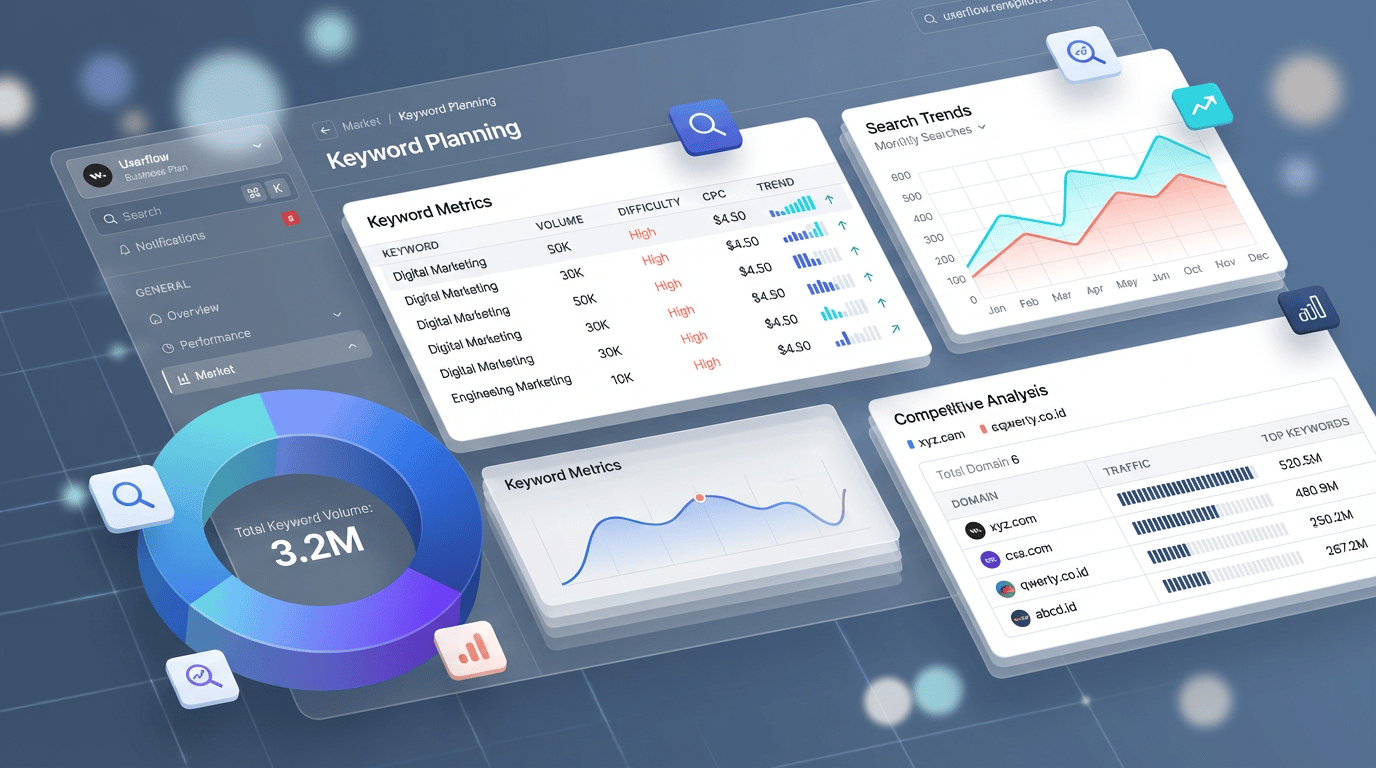
Google Keyword Planner researches search-advertising keywords, historical demand, and campaign forecasts. Tool access and advertising charges are separate, but Google's current guidance requires completion of Google Ads account setup, including billing information, to access basic features. A free Google account alone does not guarantee unrestricted access.
Check Google's getting-started instructions. Review billing setup separately from whether a campaign is enabled, so research does not accidentally become an advertising launch.
Align the research conditions
Find Keyword Planner under Tools in Google Ads. Account setup and interface variations can change what appears, so do not rely on an old “create without a campaign” path as a universal procedure.
Condition | Decide | Why it matters |
|---|---|---|
Location | Actual target country or service area | Global demand is not local demand |
Language | Customer language | Different markets can generate different suggestions |
Network | Consistent research coverage | Different networks change the comparison |
Period | Recent, typical, or seasonal period | Seasonality can look like growth or decline |
Purpose | Paid search, SEO, or list forecasting | Advertising competition is not SEO difficulty |
Follow Google's keyword-refinement guidance and save the retrieval date and targeting with every export.
Choose the right workflow
Discover new keywords
Start with relevant products, services, customer problems, or a website. Separate generic categories from uses, pricing, comparisons, and implementation questions. Remove irrelevant suggestions and group variants that represent the same intent rather than creating a page for every wording.
Get search volume and forecasts
Enter an existing list to examine historical statistics and forecast advertising performance. Forecasts depend on inputs such as bids, budgets, and dates. Historical demand, a planned campaign, and delivered campaign results are different datasets.
Interpret the metrics correctly
Metric | What it represents | What it does not prove |
|---|---|---|
Average monthly searches | Rounded historical estimates under selected conditions, including close variants | Exact people or future visits to your article |
Competition | Competition among advertisers | Organic ranking difficulty |
Top-of-page bid low/high range | Approximately the 20th/80th percentiles of historical bids | Your guaranteed future CPC |
Forecast average CPC | A prediction under the plan's assumptions | Actual delivery or the historical bid range |
See Google's historical statistics and forecasting definitions. Values may be rounded or shown as ranges. A small advertising purchase does not guarantee exact search-volume data, and another research tool is also subject to estimates and coverage limits.
Actual average CPC is total click cost divided by total clicks. In a fictional example using Japanese yen, ¥30,000 of click cost divided by 100 clicks equals ¥300. That is a calculation from delivered results, not a forecast. Consult Google's average CPC definition and the paid search guide when planning costs.
Use a separate SEO assessment
Low advertising competition does not mean a new website can easily rank organically. Inspect actual results for the intended country and device, noting the date. Determine whether users expect explanations, products, comparisons, or local businesses, then assess whether your organization can provide a useful answer.
Do not classify difficulty or “long tail” solely by word count. Consider specificity, demand, commercial relevance, and your ability to satisfy the need. A low-volume implementation or troubleshooting topic can still matter to customers. Use the SEO basics checklist to turn the research into a page.
Record the selection rationale
This fictional B2B example contains research fields rather than invented search volumes.
Topic | Customer need | Planner fields | Separate SEO assessment |
|---|---|---|---|
Annual marketing budget | Allocate and review spending | Location, period, searches, bid range | Need for a usable table and worked example |
What is advertising? | Understand a broad concept | Same research conditions | Intent breadth and overlap with existing pages |
Budget-management tool comparison | Choose a product | Same research conditions | Fair criteria and verified feature evidence |
Revisit the decision with observed results
Save the keywords, conditions, rationale, target page, owner, and review date. After publication, use Search Console to inspect actual queries and displayed URLs. For ads, inspect search terms and verified outcomes. Evaluate clicks with the CTR guide, and do not present a demand estimate as a guaranteed business result.
Keep advertising and editorial lists distinct
An ad list needs a matching and exclusion strategy, followed by a review of actual search terms. An editorial list needs a question, page role, and evidence requirements. A selected keyword does not imply exact-match-only delivery, and every wording variant does not require a separate article. Group candidates by the customer problem before assigning production work.