The Difference and Relationship Between LTV and CAC | How to Read Unit Economics
Shusaku Yosa
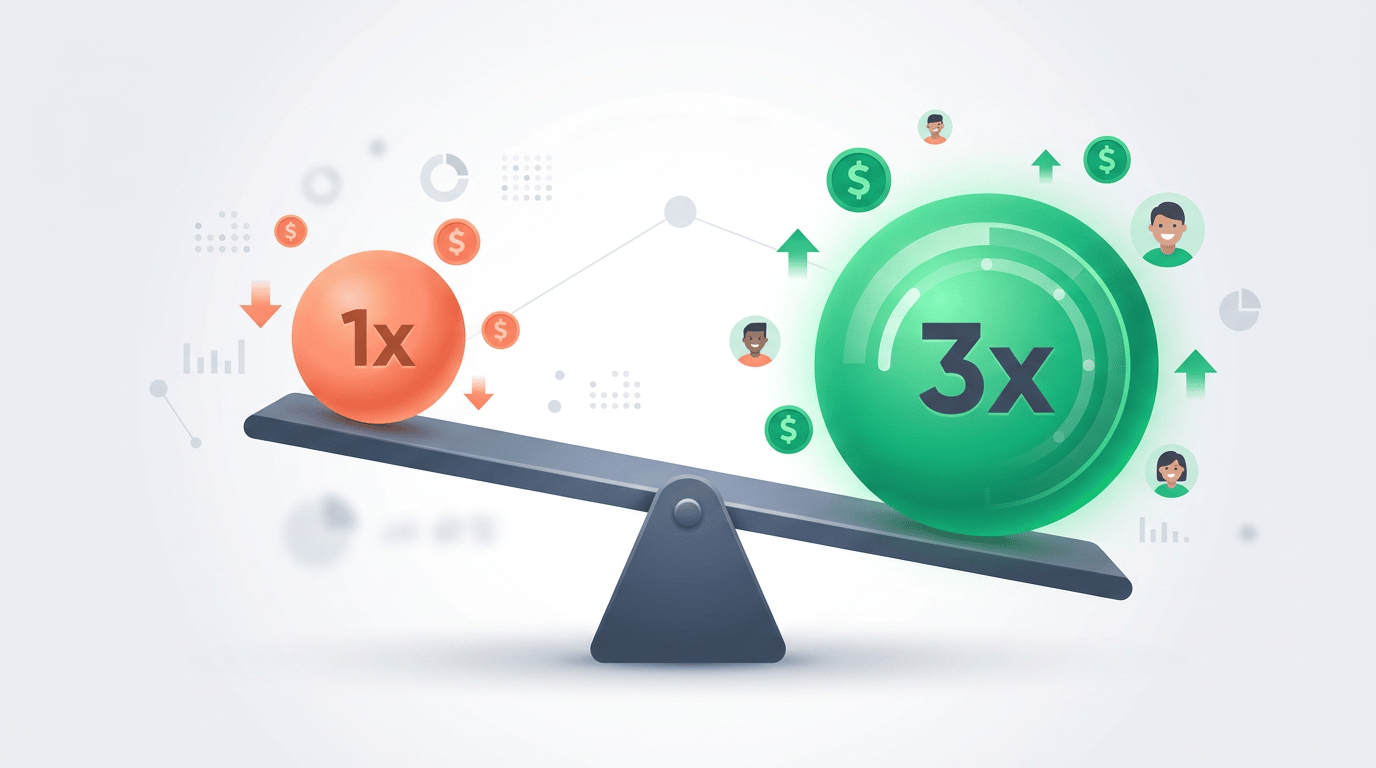
LTV and CAC are two metrics that are indispensable for measuring the profitability of subscription and SaaS businesses. In SaaS, where the upfront investment is not yet recovered at the point a customer is acquired and profit is generated only through continued use, grasping the balance between "the value one customer brings" and "the cost to acquire one customer" becomes the lifeline of the business. The metric that shows this balance is unit economics. This article explains, in an easy-to-understand way, the meaning and calculation of LTV and CAC, the difference and relationship between the two, and how to read and improve unit economics.
What is LTV?
LTV (Life Time Value) is a metric that represents the total profit a single customer brings to your company from the start of the relationship until it ends. The longer customers keep using the service, and the higher the unit price, the larger the LTV becomes.
There are several ways to calculate LTV depending on the business model, but in subscription types such as SaaS, the following formula using the churn rate is often used.
LTV = Average customer unit price x Gross margin (%) / Churn rate (%)
For example, for a service at 1,500 yen per month with a 40% gross margin and a 3% monthly churn rate, LTV = 1,500 x 0.4 / 0.03 = 20,000 yen. What is important here is that the churn rate is in the denominator of LTV. The lower the churn rate, the larger the LTV; for example, if the monthly churn rate is halved from 2% to 1%, the average customer lifetime doubles and LTV roughly doubles as well. In other words, improving retention (customer retention) ties directly to improving LTV.
What is CAC?
CAC (Customer Acquisition Cost) is a metric that represents the total cost of acquiring one new customer. The formula is simple, as follows.
CAC = Total cost spent on customer acquisition / Number of new customers acquired
For example, if you spent 2 million yen on marketing and sales combined and acquired 5 new customers, CAC = 2 million yen / 5 customers = 400,000 yen. The "cost" here should accurately include not only advertising expenses but also sales activity costs and related personnel costs. The measurement period is divided by month, quarter, year, and so on, according to the business type and purpose.
The difference between CAC and CPA
A metric easily confused with CAC is CPA (Cost Per Acquisition). The biggest difference between the two is the scope of costs covered. Whereas CPA is a "micro" metric that mainly refers to the cost per conversion in a specific initiative such as web advertising, CAC is a "macro" metric that includes sales costs and personnel costs beyond advertising and looks at the customer acquisition efficiency of the entire business. Use CPA when looking at the cost-effectiveness of individual initiatives, and CAC when looking at the profitability of the whole business, choosing according to your purpose.
The difference and relationship between LTV and CAC
LTV and CAC are, so to speak, in a paired relationship of "the value gained from a customer" and "the cost to gain a customer." Laying the two side by side clarifies each one's role.
- LTV: The profit a customer brings over their lifetime (the return / the side being recovered)
- CAC: The cost to acquire one customer (the investment / the side to be recovered)
For a business to be viable, the profit gained from a customer (LTV) must exceed the cost spent acquiring that customer (CAC). A state in which LTV is below CAC means that the more customers you acquire, the more the deficit grows. By looking at the ratio of these two metrics, you can judge whether the business is in a state where it can grow soundly. That is the unit economics explained next.
What is unit economics?
Unit economics is the idea of analyzing profitability with one customer as the "unit." It is calculated with the following formula using LTV and CAC.
Unit economics = LTV / CAC
For example, if LTV is 166,000 yen and CAC is 50,000 yen, unit economics is 166,000 / 50,000 = 3.32. This number represents how many times over the profit gained from one customer can recover that customer's acquisition cost. It is a metric that is particularly emphasized in businesses where revenue accumulates, such as SaaS.
The benchmark and how to read unit economics
Unit economics is generally judged for soundness at roughly the following levels.
- Below 1: Unsound (deficit). The acquisition cost exceeds the profit gained from the customer, a state in which losses grow the more you acquire.
- 1 to 3: Profitable but requires caution. You are recovering costs, but the capacity for growth investment is limited.
- 3 or above: The benchmark considered sound. A state in which LTV is at least 3 times CAC.
- Above 5: Possible under-investment. There may be room to grow faster by increasing investment in new acquisition.
In general, in SaaS businesses, "LTV / CAC > 3 (the 3x rule)" is regarded as the benchmark for soundness. However, this is not an absolute standard, and the appropriate value changes depending on the business model and business stage. For example, in the early stage or at a new launch, CAC tends to be high in order to gain market share, and the ratio may temporarily be lower.
Why "3x" is the benchmark for soundness
The number 3 is derived in reverse from two KPIs considered sound in SaaS. One is that the CAC payback period is within 12 months, and the other is that the monthly churn rate is below 3%. A 3% monthly churn rate corresponds to an average customer lifetime of about 33 months (1 / 0.03), and when these sound levels are met, unit economics converges to roughly 3. Because this rule of thumb is backed by the track records of many SaaS companies, 3x has become established as the benchmark.
Also look at the CAC payback period
As important as unit economics is the CAC payback period. This refers to the time it takes to fully recover CAC with the profit gained from a customer, and within 12 months is generally considered desirable. Whereas unit economics shows "how many times over you can recover in the end," the CAC payback period shows "how quickly you can recover." The faster the recovery, the more stable the cash flow and the faster the reinvestment cycle can be, so it is important to check both together.
How to think about improving unit economics
Improving unit economics is considered in two directions: raising LTV, which is the numerator, or lowering CAC, which is the denominator.
Measures to raise LTV
- Lower the churn rate: Because the churn rate is in the denominator of LTV, improving retention has the largest impact. Optimizing onboarding and strengthening customer success are effective.
- Raise the unit price: Through upselling, cross-selling, and guiding customers to higher-tier plans, increase the average unit price per customer.
- Improve the gross margin: By optimizing the cost of provision, increase the profit per customer for the same revenue.
Measures to lower CAC
- Optimize acquisition channels: Grasp CAC by channel and reallocate budget to more efficient channels.
- Raise the conversion rate: By improving landing pages and the sales process, acquire more customers for the same cost.
- Leverage referrals from existing customers: Word of mouth and referrals have low acquisition costs and contribute to lowering CAC.
Note that a value that is too high (for example, above 5) is not necessarily a good state. Because there may be insufficient reach to new customers and missed growth opportunities, deliberately increasing acquisition investment to accelerate growth can also be a valid decision.
Conclusion
LTV represents the profit a customer brings over their lifetime, CAC represents the acquisition cost of one customer, and unit economics (LTV / CAC), the ratio of the two, reflects the profitability of the business. In SaaS, "3 or above" is considered the benchmark for soundness, and this is a rule of thumb derived in reverse from two KPIs: a CAC payback period within 12 months and a monthly churn rate below 3%. Rather than viewing unit economics in isolation, it is important to grasp it together with the CAC payback period and churn rate. By continuously advancing the improvement of LTV and the optimization of CAC, you can build a revenue structure capable of sustainable growth.