What Is Retention Rate? Formula, the Difference from Churn, and Improvement Measures
Shusaku Yosa
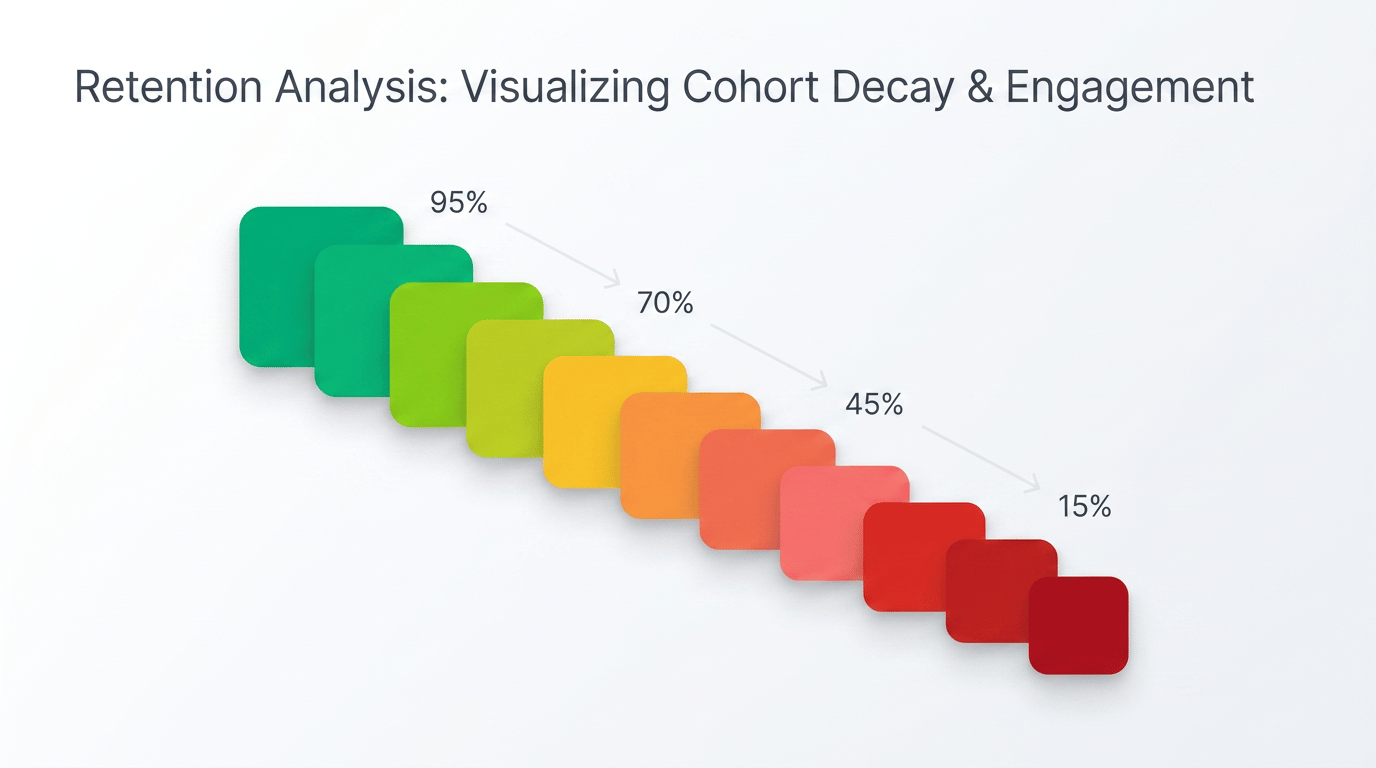
Retention rate is a metric that shows how much existing customers keep using your service, and it is indispensable for measuring the stable growth of a business. Given that acquiring new customers is said to cost many times more than retaining existing ones, correctly grasping and improving your retention rate ties directly to maximizing LTV and stabilizing your revenue base. This article explains, in an easy-to-understand way, what retention rate means and how to calculate it, the difference from the frequently confused churn rate, and improvement measures you can put into practice.
What is retention rate?
Retention is an English word meaning "to maintain" or "to keep," and in the marketing field it refers to "retaining existing customers." Retention rate is a metric that, over a given period, represents the proportion of customers who continue using your service without canceling. It is sometimes also called the "customer retention rate," "customer stickiness rate," or "continuation rate."
The higher the retention rate, the more you can judge that customers are satisfied with your service and continuously feel its value. Conversely, when the number is low or trending downward, it is a sign that customers are beginning to drift away from the service, and you need to analyze the causes and improve early.
Why retention rate is considered important
There are clear reasons why retention rate is valued as a management metric.
- More cost-efficient than new acquisition: In general, acquiring new customers is said to cost several times more than retaining existing ones (the 1:5 rule). Retaining existing customers offers higher investment efficiency.
- Maximizing LTV (lifetime value): The longer customers keep using the service, the greater the lifetime profit each one brings. Improving retention rate ties directly to improving LTV.
- Stabilizing revenue: Especially in subscription-based businesses such as SaaS, continued use is the foundation of revenue. A high retention rate supports stable recurring revenue (MRR/ARR).
- A large impact on profit improvement: Like the "5:25 rule," which holds that a 5% drop in the churn rate improves profit by at least 25%, even a small improvement in retention can lead to a large contribution to profit.
How to calculate retention rate
Retention rate can be found with a simple formula as long as you have the necessary figures. A representative formula is as follows.
Retention rate (%) = Continuing customers / New customers x 100
For example, if there were 200 new customers and 150 of them continued using the service, the retention rate is 150 / 200 x 100 = 75%. In other words, it represents a state in which 75% of acquired customers continue using the service.
To measure the retention of existing customers more strictly, the following formula, which excludes new customers, is used.
Retention rate (%) = (Total customers at the end of the period - New customers gained during the period) / Customers at the start of the period x 100
This formula removes the influence of customers newly added during the period, allowing you to purely measure "how many of the original customers remained." It is important to choose the definition that is meaningful for your company according to your purpose.
Three points when calculating
- Decide the measurement period: Set the period to match your business cycle, such as monthly, quarterly, or annually. The faster the cancellation cycle of a service, the easier it is to capture changes by measuring over a shorter period.
- Gather the necessary figures: The number of customers at the start of the period, the number at the end of the period, and the number of new customers during the period are the three basic data points.
- Observe continuously over time: Rather than a one-off number, calculating it regularly, such as monthly, and tracking the trend lets you detect the effect of measures and anomalies early.
The difference between retention rate and churn rate (cancellation rate)
Frequently appearing alongside retention rate is the churn rate (cancellation rate). The two are two sides of the same coin, and it becomes easier to understand if you treat them as antonyms. Whereas retention rate shows "how many customers continued," churn rate shows "how many customers canceled."
The basic formula for churn rate is as follows.
Churn rate (%) = Customers who canceled during the period / Customers at the start of the period x 100
When based on the same population, retention rate and churn rate add up to 100%. In other words, if you know one, you can grasp the other.
Retention rate (%) = 100 - Churn rate (%)
Note that, in addition to customer churn rate based on the "number of customers," there is also revenue churn rate (MRR-based), which measures the impact of cancellations on revenue. When a high-priced-plan customer cancels, the decrease in the number of customers may be small but the blow to revenue is large, so looking at both together lets you grasp the reality of cancellations more accurately.
Points to note when comparing retention rates
A calculated retention rate is a metric that is difficult to judge as good or bad on its own. In addition to a time-series comparison with your company's past figures, if possible, compare it against industry benchmarks and evaluate relatively whether it is high or low. Because the "healthy level" varies greatly by industry and business model, be careful not to directly apply figures from other industries.
Main causes of a declining retention rate
Before considering improvement measures, it is important to grasp why customers are leaving. Typical causes of a declining retention rate include the following.
- Stumbling at onboarding: A case where customers cannot use the service right after signing up and drop off before experiencing its value.
- Value is not fully communicated: A state in which features and benefits are not understood by customers, who lose their "reason to use" the service.
- Usability/UX problems: UX deficiencies such as confusing screens or cumbersome operations become a source of stress and lead to cancellation.
- Insufficient support structure: If questions and troubles cannot be resolved smoothly, customer satisfaction declines.
- Competitor and pricing factors: External and internal factors such as attractive competitor campaigns, your own price increases, and defects or system failures also have an impact.
Measures to improve retention rate
Improving retention rate comes down to the essence of "having customers experience value worth continuing to use." Depending on the cause, you combine measures such as the following.
1. Optimize onboarding
Onboarding, which smoothly connects from signup to service adoption, is the most important point for preventing early drop-off. Prepare tutorials, guides, and support at the start of use, and design the experience so customers reach a "success experience (a sense of value)" as quickly as possible.
2. Continuous communication with customers
Through email, in-app notifications, sharing of use cases, and so on, continuously provide touchpoints where customers can re-recognize the value of the service. Personalized guidance based on usage status is effective for maintaining engagement.
3. Detect signs of cancellation early
Capture changes in behavior that lead to cancellation, such as a drop in login frequency or a decrease in features used, as warning signs, and approach high-risk customers individually. The key is to get ahead of it at the warning stage rather than responding after a cancellation.
4. Collect customer feedback and reflect it in improvements
Combine quantitative data such as surveys and NPS studies with qualitative data such as interviews with churned customers to grasp the root causes of drop-off in three dimensions. Identify the essential issues behind surface voices like "the price is too high"—such as "the value was not communicated"—and connect them to improvements in the product and communication.
5. Leverage a customer community
A community where users can share know-how and success stories with one another functions as a place where customers rediscover the value of the service and increase their usage. Connections among customers nurture attachment (loyalty) to the service and contribute to lowering the cancellation rate.
Conclusion
Retention rate is found with formulas such as "Continuing customers / New customers x 100" and is a metric that shows how well existing customers are retained. It is two sides of the same coin with churn rate (cancellation rate), in the relationship "Retention rate = 100 - Churn rate." By observing the number continuously and pursuing improvement through measures such as optimizing onboarding, continuous communication, detecting churn signs, reflecting customer feedback, and leveraging a community, you can connect it to improving LTV and building a stable revenue base. Start by accurately grasping where your company stands now.