Tips for Operating Toward KPI Achievement: Progress Management and Recovery
Shusaku Yosa
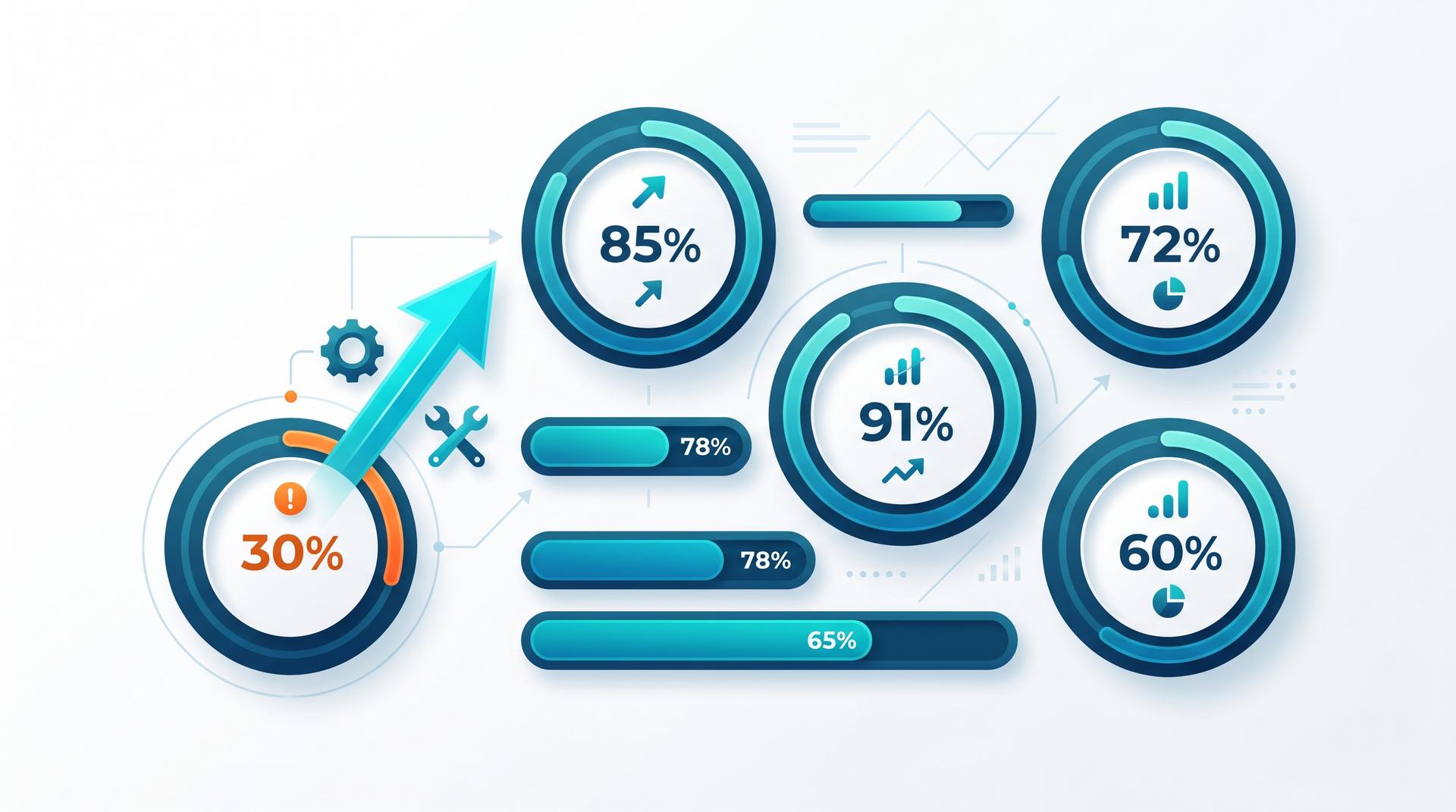
"The KPIs we set at the start of the period quietly slip to the finish line unmet." "We track the numbers, yet we can't tell where things fell behind." Many teams set KPIs only to stumble in the day-to-day execution that leads to achievement. A KPI is not something you set and forget. You only get close to hitting it when you have an operating rhythm: checking progress frequently, and recovering quickly the moment you notice a delay. This article first clarifies what KPI achievement means, then walks through the typical causes of missed targets, how to run progress management in practice, how to read achievement rates, and the steps for recovering lost ground.
What Is KPI Achievement? How It Differs from Reaching a Goal
KPI achievement means meeting, within the deadline, the target value of a KPI (Key Performance Indicator) you have set in advance. A KPI is an "intermediate metric" derived by breaking down a KGI (Key Goal Indicator), the ultimate goal. Hitting your KPIs one by one is the path toward achieving the KGI.
One point worth keeping in mind here: "achieving the KPI" and "achieving the objective" are not necessarily the same thing. If you set "number of meetings" as a KPI, you may hit the meeting target yet still fail the real objective if it doesn't translate into orders (the KGI). When pursuing KPI achievement, you must constantly check whether the metric is properly linked to the KGI—that is, whether the relationship "hitting this KPI brings us closer to results" actually holds.
For the basic role of KPIs and how to set them, see our separate article "What Are KPIs in Business? Roles, the Setup Process, and Tips for Operation" as well.
Typical Causes of Missed KPIs
Before thinking about how to operate for achievement, it helps to understand why KPIs end up unmet. Most causes lie less in the KPI itself and more in how it is operated.
- Checking progress too infrequently: If you only review at month-end or quarter-end, by the time you notice a delay it's too late to recover.
- Unrealistic KPI settings: Targets that are too high with little basis make the field give up early with a "this is impossible anyway" attitude.
- Ignoring leading indicators: Chasing only result metrics (lagging indicators) like sales or orders, without managing the upstream process metrics, means your moves are always reactive.
- No defined action for misses: Even when you know you're behind, "what to do next" isn't prepared, so the response depends on individuals.
- Too many KPIs: With too many metrics to chase, management of each becomes shallow, and in the end everything is half-done.
How to Run Progress Management That Supports KPI Achievement
The single biggest factor that decides KPI achievement is day-to-day progress management. The key is to manage it "frequently, with the right metrics, and in a way everyone can see."
1. Decide the Frequency and Cycle for Checking Progress
First, decide a check frequency for each KPI. As a guide, metrics that move daily—like sales activity volume or inquiry counts—are checked daily to weekly, while sales-type metrics that accumulate monthly are checked weekly to monthly. What matters is to make "who checks which numbers, and when" a rule, and to fix the venue for checking (morning huddles, weekly meetings, etc.). The less checking is habitual in an organization, the later delays get noticed.
2. Detect Anomalies Early with Leading Indicators
KPIs include "lagging indicators" that appear as results, and "leading indicators" upstream that produce those results. For example, against orders (a lagging indicator), the number of meetings, proposals, and calls are leading indicators. Because acting only after a lagging indicator worsens is too late, monitoring whether leading indicators are falling below target and acting early greatly influences your achievement rate.
3. Make "Plan vs. Actual" Visible with a Progress Table
Indispensable to managing progress is "plan-vs-actual management," placing the plan (budget) and actuals side by side. Giving your KPI progress table at least the following columns makes delays and their causes easier to see.
- Target value (plan): The number to achieve at period-end, and milestones allocated by month and week.
- Actual value: The real number as of now.
- Achievement rate: Actual / target. Shows the degree of progress at a glance.
- Variance to plan: Whether you are ahead of or behind the planned pace.
- Projected landing: The forecast end-of-period value if the current pace continues.
You can start managing this in spreadsheet software, but data updates become manual, and as metrics increase, aggregation and sharing take more effort. When you want to grasp progress across multiple KPIs, building a mechanism that automatically consolidates data and visualizes plan-vs-actual and achievement rates on a dashboard lets you keep progress management fresh while reducing operating load.
How to Read Achievement Rates and Think About Projected Landing
At the center of progress management is the "achievement rate." It is calculated as follows.
Achievement rate (%) = Actual value / Target value x 100
However, looking at the achievement rate alone partway through a period is dangerous. For example, even a monthly achievement rate of 50% may be on track if it's still early in the month, but it's a major delay if the month is nearly over. This is where comparison with the "progress rate (time elapsed)" becomes important.
For instance, if two-thirds of the month has passed (66% time elapsed) and the achievement rate is 50%, you can judge that the pace is behind. Conversely, an 80% achievement rate means you're running ahead of schedule.
Even more effective is to project the "landing." Estimate where you'll land if you simply extend the current pace, and grasp the gap (shortfall) from the target. This shortfall is precisely the "amount of recovery" you need to make up from here. Think of the achievement rate as the report card of the present and projected landing as a warning light for the future, and the numbers to watch become easier to organize.
How to Recover Lost Ground
When you find a delay, shouting "let's try harder" by feel won't recover it. Recovery is translated into concrete action through the following steps.
- Fix the shortfall as a number: From the gap between projected landing and target, produce a concrete figure to add by period-end (e.g., 20 more meetings).
- Identify the bottleneck: Break the KPI down into its process and pinpoint where the numbers are dropping. The move changes completely depending on whether meetings are short, or meetings exist but the close rate is low.
- Choose moves, assign owners and deadlines: Against the bottleneck, choose feasible measures—more calls, added lists, revised talk tracks, additional proposals to existing customers—and clarify "who, by when."
- Verify effects in short cycles: Check recovery measures at shorter-than-usual intervals (e.g., daily), and if they aren't working, switch to another approach early.
Also, if you judge that internal resources alone can't make up the gap by period-end, sharing a KPI reset or the impact on the higher KGI with stakeholders early is part of honest recovery. Widening the range of options at the forecast stage, rather than reporting after it's too late, ultimately minimizes the damage.
Tips for Operating to Raise KPI Achievement Rates
Finally, here are the operating tips for continually achieving KPIs.
- Raise the check frequency: The earlier you notice a delay, the easier it is to recover. The more important the metric, the shorter the check cycle.
- Act on leading indicators: Detect anomalies in upstream process metrics rather than waiting for results to appear.
- View plan-vs-actual and projected landing together: Beyond the current achievement rate, always grasp where you'll land if things continue.
- Decide the action for misses in advance: Build into your operating rules something like "if the achievement rate drops below a threshold, do X."
- Narrow KPIs and review them regularly: Limit the metrics you chase to ones that truly work, and swap out KPIs that no longer link to the KGI.
Summary
KPI achievement means meeting the target value of a set intermediate metric within the deadline, and its success is decided by day-to-day operation. The keys are: detecting delays early through frequent progress management, looking at leading indicators rather than only result metrics, and grasping the shortfall as a number from the achievement rate and projected landing, then recovering with a clear aim at the bottleneck. The difficulty of recovery is decided "at the moment you notice" a delay. Rather than setting KPIs and forgetting them, building an operating mechanism that visualizes plan-vs-actual and reacts quickly to signs of a miss is the single shortest path to KPI achievement.